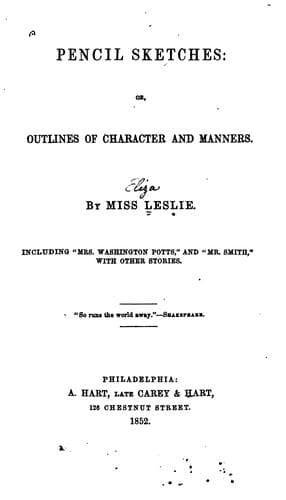
Pencil Sketches; or, Outlines of Character and MannersLeslie, Eliza
General
Pencil Sketches; or, Outlines of Character and Manners
Leslie, Eliza
Humorous stories; Short stories, American; United States -- Social life and customs -- 19th century -- Fiction
Fanny shuddered at the bitter and implacable tone in which these words
were uttered, and the Brighams were convinced that, with such a parent,
Miss Osborne's home could at no time have been a happy one.
"But," continued old Culpepper, after a pause, "I will confess, that
since I have been in your country, I have felt some 'compunctious
visitings;' and I had determined not to leave the States without making
some inquiry as to my daughter having left children."
"She had only Oliver," replied Colonel Brigham.
"The boy's features have no resemblance to those of his mother," said
Culpepper; "still there is something in his look that at once
prepossessed me in his favour. But tell me all that you know about his
parents?"
The colonel's narrative implied, that he had been well acquainted with
Captain Dalzel, who was of the Virginia line, and who was mortally
wounded at Yorktown, where he died two days after the surrender;
consigning to the care of Colonel Brigham a miniature of his wife, which
he said was procured before his marriage from an artist whom he had
induced to copy privately one that he was painting for the young lady's
father.
The war being now considered as ended by the capture of Cornwallis and
his army, Colonel Brigham repaired to Philadelphia, where her husband
had informed him that Mrs. Dalzel was living in retired lodgings. He
found that the melancholy news of Captain Dalzel's fate had already
reached her; and it had caused the rupture of a blood-vessel, which was
hurrying her immediately to the grave. She was unable to speak, but she
pointed to her child (then about four years old), who was sobbing at her
pillow. The colonel, deeply moved, assured her that he would carry the
boy home with him to his wife, and that while either of them lived, he
should never want a parent. A gleam of joy lighted up the languid eyes
of Mrs. Dalzel, and they closed to open in this world no more.
The anguish evinced by Mr. Culpepper at this part of the narrative, was
such as to draw tears from Mrs. Brigham and Fanny. The colonel dwelt no
further on the death of Mrs. Dalzel, but concluded his story in as few
words as possible, saying that he carried the child home with him; that
his wife received him gladly; and that not one of the relations of
Captain Dalzel (and he had none that were of near affinity) ever came
forward to dispute with him the charge of the boy. Captain Dalzel, he
knew, had possessed no other fortune than his commission.
When Colonel Brigham had finished his tale,----
"Well," said Mr. Culpepper, making a strong effort to recover his
composure, "perhaps I treated my daughter too severely, in continuing to
cherish so deep a resentment against her. But why did she provoke me to
it? However, the past can never be recalled. I must endeavour to make
her son behave better to me. Where is Oliver? Let me see him
immediately."
Public-domain text, read in full here on John Shaqi.
Reviews
Reviews
No reviews yet
Be the first to share your thoughts on this work.
Elsewhere in the archive
Join the Discussion
Join the discussion
Sign in to leave a comment or review.
Sign InorCreate an account