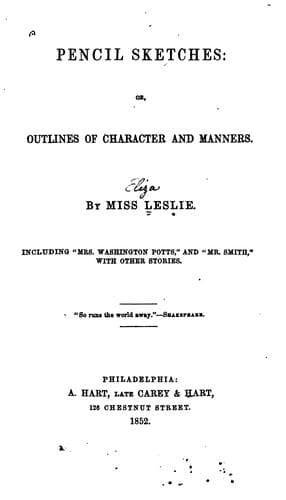
Pencil Sketches; or, Outlines of Character and MannersLeslie, Eliza
General
Pencil Sketches; or, Outlines of Character and Manners
Leslie, Eliza
Humorous stories; Short stories, American; United States -- Social life and customs -- 19th century -- Fiction
Oakland Farm, as we have said, lay some miles from the great highway,
and Lindsay was glad to find with how much ease he recollected the
turnings and windings of the by-roads. It even gave him pleasure to
recognise a glen at the bottom of a ravine thickly shaded with crooked
and moss-grown trees, where half a century ago a woman had been guilty
of infanticide, and whose subsequent execution at the county town is
talked of still; it being apparently as well remembered as an event of
yesterday. The dogwood and the wild grape vine still canopied the fatal
spot, for the thicket had never been cleared away, nor the ground
cultivated. A little beyond, the road lay through a dark piece of woods
that countrywomen, returning late from the store, were afraid to ride
through after night-fall; as their horses always started and trembled
and laid back their ears at the appearance of a mysterious white colt,
which was frequently seen gamboling among the trees, and which no
sensible people believed to be a real or living colt, as one horse is
never frightened at the sight of another. Shortly after, our traveller
stopped for a few moments to gaze at the transformation of a building on
the verge of a creek. He had remembered it as a large old house
chequered with bricks alternately blackish and reddish, and having dark
red window-shutters with holes cut in them to admit the light; some of
the apertures being in the form of hearts, others in the shape of
crescents. There had been a red porch, and a red front door which for
years had the inconvenient property of bursting open in the dead of
night; at which time, a noise was always heard as of the hoofs of a calf
trotting in the dark, about the rooms up stairs. This calf was finally
spoken to by a very courageous stranger, who inquired its name. The calf
made not a word of answer, but from that night was heard no more. This
house, being now painted yellow, and the red shutters removed, had been
altered into an establishment for carding and spinning wool, as was
evident by surrounding indications, and by the noise of the machinery,
which could be heard plainly as far as the road. Lindsay began to fear
that he should never again see Polly Nichols, a tall, gaunt,
hard-featured spinning girl, whose untiring strength and immoveable
countenance, as she ran all day at the "big wheel," had often amazed
him, and whom Mrs. Hilliard considered as the princess of wool-spinners.
His conscience reproached him with having one day, while she was at
dinner, mischievously stolen the wheel-finger of the said Polly Nichols,
and hidden it in the dough trough, thereby occasioning a long search to
the industrious damsel, and the loss of an hour's spinning to Mrs.
Hilliard.
Public-domain text, read in full here on John Shaqi.
Reviews
Reviews
No reviews yet
Be the first to share your thoughts on this work.
Elsewhere in the archive
Join the Discussion
Join the discussion
Sign in to leave a comment or review.
Sign InorCreate an account