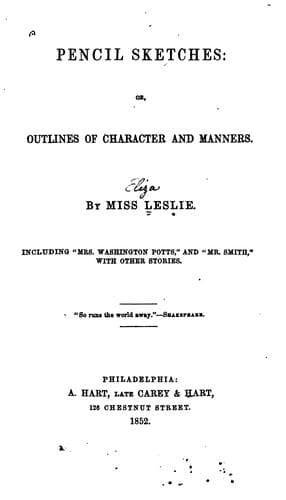
Pencil Sketches; or, Outlines of Character and MannersLeslie, Eliza
General
Pencil Sketches; or, Outlines of Character and Manners
Leslie, Eliza
Humorous stories; Short stories, American; United States -- Social life and customs -- 19th century -- Fiction
He next came to the old well-known meeting-house, embosomed in large
elms of aboriginal growth. He saw it as in former days, with its long
range of stalls for the horses of the congregation, and its square
horse-blocks at the gate with steps ascending on all their four sides,
to which the country beaux gallantly led up the steeds of the country
belles. Just beyond the meeting-house, he looked in vain for a
well-known little brook, distinguished of old as "Blue Woman's Run," and
which had formerly crossed the road, murmuring over its bed of pebbles.
It had derived this cognomen from the singular apparition of a woman in
a blue gown, with a pail of water on her head, which had on several
Sundays boldly appeared even in the brightness of the noon-day sun, and
was seen walking fearlessly among the "meeting folks," and their horses,
as they stopped to let them drink at the brook; coming no one knew from
whence, and going no one knew where; but appearing and disappearing in
the midst of them. But the streamlet was no longer there, diverted
perhaps to some other channel, and the hollow of its bed was filled up
and made level with the road.
About two miles further, our hero looked out for a waste field at some
distance from the road, and distinguished by an antique persimmon tree
of unusual size. This field he had always known of a wild and desolate
aspect, bristled with the tall stalks of the mullein. Here, according to
tradition, had once lived a family of free negroes, probably runaways
from the south. They had lost their children by an epidemic, buried them
at the foot of the persimmon tree, and soon after quitted the
neighbourhood. All vestiges of their hut had vanished long before Edward
Lindsay had known the place, but the graves of the children might have
been traced under the grass and weeds. The deserted field had the
reputation of being haunted, because whoever had the temerity to cross
it, even in broad daylight, never failed, that is if they had faith, to
see the faces of two little black boys looking out from behind the tree,
and laughing merrily. But on approaching the tree no black boys were
there.
There is considerable variety in American ghosts. In Europe these
phantoms are nearly all of the same stamp: either tall white females
that glide by moonlight among the ruined cloisters of old abbeys; or
pale knights, in dark armour, that wander, at midnight, about the
turrets and corridors of feudal castles. In our country, apparitions go
as little by rule as their living prototypes; and are certainly very
prosaic both in looks and ways.
The old persimmon tree was still there; but the field had been
cultivated, and was now in red clover, and Lindsay knew that mind had
marched over it.
Public-domain text, read in full here on John Shaqi.
Reviews
Reviews
No reviews yet
Be the first to share your thoughts on this work.
Elsewhere in the archive
Join the Discussion
Join the discussion
Sign in to leave a comment or review.
Sign InorCreate an account