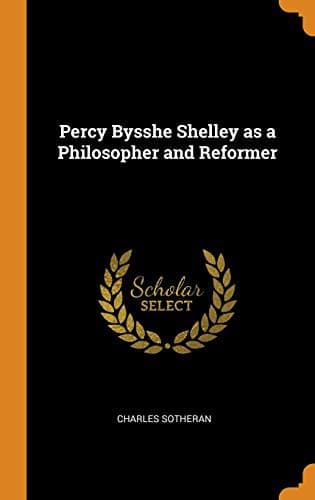
Percy Bysshe Shelley as a Philosopher and Reformer — John Shaqi
Percy Bysshe Shelley as a Philosopher and ReformerSotheran, Charles
Philosophy
Percy Bysshe Shelley as a Philosopher and Reformer
Sotheran, Charles
Shelley, Percy Bysshe, 1792-1822 -- Philosophy; Shelley, Percy Bysshe, 1792-1822 -- Political and social views
With the enlightenment of the present century in every department of
knowledge, so has a corresponding degree of advancement been thrown on
the science of history, which Shelley only partially apprehended. An
enormous amount of new information is now to be gleaned from the
writings of Ewald, Fergusson, Bunsen, Deutsch, Max Muller,
Baring-Gould, Stanley, and other scholars of Orientation, which shows
that the Hebrews, like every other nation, passed through the various
phases of Nomadism and Pastoralism, to that of offensive and defensive
war. The same as other races, they came through the usual steps in
religious progress--Fetishism, Astrolatry, Polytheism and Monotheism.
During phases in their history they participated in the various forms
of tree and serpent, Phallic, or fire-worship. They had, as the
Talmud, Targums, and the Old Testament show, a knowledge of the
Egyptian or Chaldaic account of the creation and fall, the latter
still to be seen on the walls of the temple of Osiris at Philae. They
had much knowledge of the Cabala, through their great prophet Moses,
who was "learned in all the wisdom of the Egyptians," and, like
Pythagoras, had been initiated into their mysteries, and who both
imparted the knowledge in part to their compatriots, on which they
both founded systems.
A great traveler, and most learned modern writer on Occultism, who
claims, on good grounds, to have been received into the ancient branch
of the Rosie Cross in the far East, Madame Helena P. de Blavatsky,
imparts the following particulars: "The first Cabala in which a mortal
man ever dared to explain the greatest mysteries of the universe, and
show the keys to those masked doors in the ramparts of Nature, through
which no mortal can ever pass without rousing dread sentries never
seen upon this side her wall, was compiled by a certain Simeon Ben
Jochai, who lived at the time of the second temple's destruction. Only
about thirty years after the death of this renowned Cabalist, his MSS.
and written explanations, which had till then remained in his
possession as a most precious secret, were used by his son, Rabbi
Elizzar, and other learned men. Making a compilation of the whole,
they so produced the famous work called _Zohar_ (God's splendor). This
book proved an inexhaustible mine for all the subsequent Cabalists,
their source of information and knowledge, and all more recent and
genuine Cabalas were all more or less carefully copied from the
former. Before that, all the mysterious doctrines had come down in an
unbroken line of merely oral tradition as far back as man could trace
himself on earth. They were scrupulously and jealously guarded by the
wise men of Chaldea, India, Persia and Egypt, and passed from one
initiate to another, in the same purity of form as when handed down to
the first man by the angels, students of God's great Theosophic
seminary."
Public-domain text, read in full here on John Shaqi.
Reviews
Reviews
No reviews yet
Be the first to share your thoughts on this work.
Join the Discussion
Join the discussion
Sign in to leave a comment or review.
Sign InorCreate an account