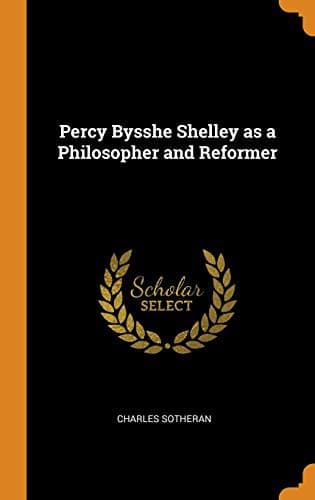
Percy Bysshe Shelley as a Philosopher and Reformer — John Shaqi
Percy Bysshe Shelley as a Philosopher and ReformerSotheran, Charles
Philosophy
Percy Bysshe Shelley as a Philosopher and Reformer
Sotheran, Charles
Shelley, Percy Bysshe, 1792-1822 -- Philosophy; Shelley, Percy Bysshe, 1792-1822 -- Political and social views
"Like a poet hidden,
In the light of thought,
Singing hymns unbidden,
Till the world is wrought
To sympathy with hopes and fears, it heeded not,"
pouring out such bursts of song as to make one almost worship and
credit the fables, taught in childhood at our mothers' knees, of the
angelic symphonies of heavenly choirs. Such was the poetry of Shelley;
and as the music of the nightingale or the skylark is far exceeding in
excellence that of the other members of the feathered kingdom, so does
Shelley rank as a poet far above all other poets, making even the poet
of nature, the great Wordsworth himself, confess that Shelley was
indeed the master of harmonious verse in our modern literature. It is
broadly laid down in the Marvinian theory that all poets are insane. I
would much like to break a lance with the learned Professor of
Psychology and Medical Jurisprudence; but as the overthrow of this
dogma does not come within the scope of my essay, I would suggest to
those who may have been influenced by that paper to read Shelley's
"Defence of Poetry." I shall quote two extracts therefrom, each
pertinent to my subject. The first describes the function of the poet:
"But poets, or those who imagine and express this
indestructible order, are not only the authors of language
and of music, of the dance, and architecture, and statuary,
and painting; they are the institutors of laws, and the
founders of civil society, and the inventors of the arts of
life, and the teachers, who draw into a certain propinquity
with the beautiful and the true, that partial apprehension
of the agencies of the invisible world, which is called
religion."
The other is in extension of the same idea, and concludes the essay:
"Poets are the hierophants of an unapprehended inspiration;
the mirrors of the gigantic shadows which futurity casts
upon the present; the words which express what they
understand not; the trumpets which sing to battle and feel
not what they inspire; the influence which is moved not, but
moves. Poets are the unacknowledged legislators of the
world."
I have no hesitation in saying that for treating Shelley as a
philosopher, I shall be attacked with great "positivism" by the
disciples[A] of manufacturers of bran-new Brummagen philosophies dug
out of Aristotelian and other depths to which are added new thoughts,
not their own. The reason which David Masson offers in his "Recent
British Philosophy" for placing Alfred Tennyson among the same class
is equally applicable now:
Public-domain text, read in full here on John Shaqi.
Reviews
Reviews
No reviews yet
Be the first to share your thoughts on this work.
Join the Discussion
Join the discussion
Sign in to leave a comment or review.
Sign InorCreate an account