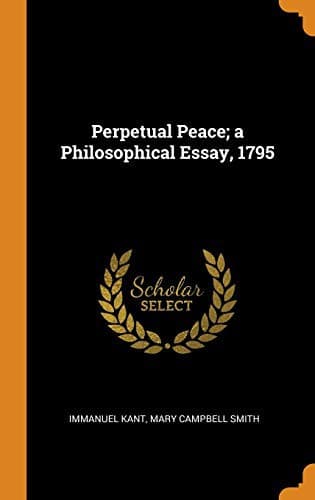
Perpetual Peace: A Philosophical EssayKant, Immanuel
PhilosophyPhilosophy
Perpetual Peace: A Philosophical Essay
Kant, Immanuel
Peace
This is, I think, the only complete translation into English of
Kant’s essay, including all the notes as well as the text, and the
translator has added a full historical Introduction, along with
numerous notes of her own, so as (in Professor Ritchie’s words)
“to meet the needs (1) of the student of Political Science who
wishes to understand the relation of Kant’s theories to those of
Grotius, Hobbes, Locke, Rousseau etc., and (2) of the general reader
who wishes to understand the significance of Kant’s proposals
in connection with the ideals of Peace Congresses, and with the
development of International Law from the end of the Middle Ages to
the Hague Conference.”
Although it is more than 100 years since Kant’s essay was written,
its substantial value is practically unimpaired. Anyone who is
acquainted with the general character of the mind of Kant will
expect to find in him sound common-sense, clear recognition of the
essential facts of the case and a remarkable power of analytically
exhibiting the conditions on which the facts necessarily depend.
These characteristics are manifest in the essay on _Perpetual Peace_.
Kant is not pessimist enough to believe that a perpetual peace is an
unrealisable dream or a consummation devoutly to be feared, nor is
he optimist enough to fancy that it is an ideal which could easily
be realised if men would but turn their hearts to one another. For
Kant perpetual peace is an ideal, not merely as a speculative Utopian
idea, with which in fancy we may play, but as a moral principle,
which ought to be, and therefore can be, realised. Yet he makes it
perfectly clear that we cannot hope to approach the realisation of
it unless we honestly face political facts and get a firm grasp of
the indispensable conditions of a lasting peace. To strive after the
ideal in contempt or in ignorance of these conditions is a labour
that must inevitably be either fruitless or destructive of its own
ends. Thus Kant demonstrates the hopelessness of any attempt to
secure perpetual peace between independent nations. Such nations may
make treaties; but these are binding only for so long as it is not
to the interest of either party to denounce them. To enforce them
is impossible while the nations remain independent. “There is,” as
Professor Ritchie put it (_Studies in Political and Social Ethics_,
p. 169), “only one way in which war between independent nations can
be prevented; and that is by the nations ceasing to be independent.”
But this does not necessarily mean the establishment of a despotism,
whether autocratic or democratic. On the other hand, Kant maintains
that just as peace between individuals within a state can only be
permanently secured by the institution of a “republican” (that is
to say, a representative) government, so the only real guarantee
of a permanent peace between nations is the establishment of a
federation of free “republican” states. Such a federation he regards
as practically possible.
Public-domain text, read in full here on John Shaqi.
Reviews
Reviews
No reviews yet
Be the first to share your thoughts on this work.
Join the Discussion
Join the discussion
Sign in to leave a comment or review.
Sign InorCreate an account