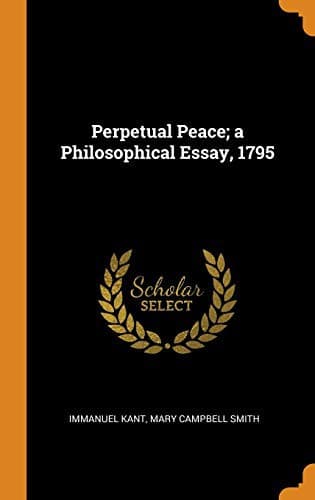
Perpetual Peace: A Philosophical EssayKant, Immanuel
PhilosophyPhilosophy
Perpetual Peace: A Philosophical Essay
Kant, Immanuel
Peace
“Having adopted from the Antonine jurisconsults,” says Maine,
“the position that the Jus Gentium and the Jus Naturæ were
identical, Grotius, with his immediate predecessors and his
immediate successors, attributed to the Law of Nature an
authority which would never perhaps have been claimed for it,
if “Law of Nations” had not in that age been an ambiguous
expression. They laid down unreservedly that Natural Law is the
code of states, and thus put in operation a process which has
continued almost down to our own day, the process of engrafting
on the international system rules which are supposed to have
been evolved from the unassisted contemplation of the conception
of Nature. There is, too, one consequence of immense practical
importance to mankind which, though not unknown during the early
modern history of Europe, was never clearly or universally
acknowledged till the doctrines of the Grotian school had
prevailed. If the society of nations is governed by Natural
Law, the atoms which compose it must be absolutely equal. Men
under the sceptre of Nature are all equal, and accordingly
commonwealths are equal if the international state be one of
nature. The proposition that independent communities, however
different in size and power, are all equal in the view of the Law
of Nations, has largely contributed to the happiness of mankind,
though it is constantly threatened by the political tendencies
of each successive age. It is a doctrine which probably would
never have obtained a secure footing at all if International Law
had not been entirely derived from the majestic claims of Nature
by the Publicists who wrote after the revival of letters.” (_Op.
cit._, p. 100.)
[28] The name “International Law” was first given to the law of
nations by Bentham. (_Principles of Morals and Legislation, XIX._
§ xxv.)
Public-domain text, read in full here on John Shaqi.
Reviews
Reviews
No reviews yet
Be the first to share your thoughts on this work.
Join the Discussion
Join the discussion
Sign in to leave a comment or review.
Sign InorCreate an account