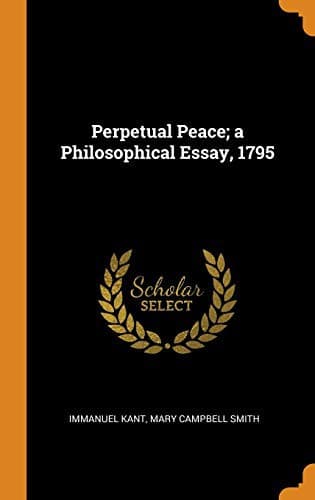
Perpetual Peace: A Philosophical EssayKant, Immanuel
PhilosophyPhilosophy
Perpetual Peace: A Philosophical Essay
Kant, Immanuel
Peace
To man nature has given none of the perfect animal equipments for
self-preservation and self-defence which she has bestowed on others
of her creatures. But she has given to him reason and freedom of
will, and has determined that through these faculties and without the
aid of instinct he shall win for himself a complete development of
his capacities and natural endowments. It is, says Kant, no happy
life that nature has marked out for man. He is filled with desires
which he can never satisfy. His life is one of endeavour and not of
attainment: not even the consciousness of the well-fought battle is
his, for the struggle is more or less an unconscious one, the end
unseen. Only in the race, and not in the individual, can the natural
capacities of the human species reach full development. Reason, says
Kant, (Prop. 2, _op. cit._) “does not itself work by instinct, but
requires experiments, exercise and instruction in order to advance
gradually from one stage of insight to another. Hence each individual
man would necessarily have to live an enormous length of time, in
order to learn by himself how to make a complete use of all his
natural endowments. Or, if nature should have given him but a short
lease of life, as is actually the case, reason would then require an
almost interminable series of generations, the one handing down its
enlightenment to the other, in order that the seeds she has sown in
our species may be brought at last to a stage of development which
is in perfect accordance with her design.” Man the individual shall
travel towards the land of promise and fight for its possession, but
not he, nor his children, nor his children’s children shall inherit
the land. “Only the latest comers can have the good fortune of
inhabiting the dwelling which the long series of their predecessors
have toiled—though,” adds Kant, “without any conscious intent—to
build up without even the possibility of participating in the
happiness which they were preparing.” (Proposition 3.)
Public-domain text, read in full here on John Shaqi.
Reviews
Reviews
No reviews yet
Be the first to share your thoughts on this work.
Join the Discussion
Join the discussion
Sign in to leave a comment or review.
Sign InorCreate an account