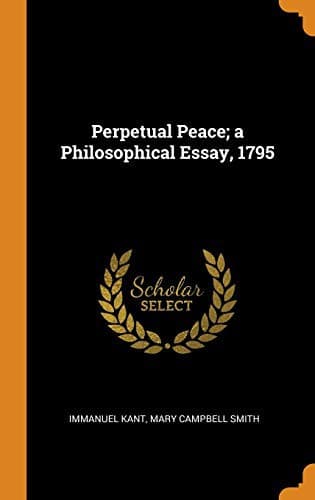
Perpetual Peace: A Philosophical Essay — John Shaqi
Perpetual Peace: A Philosophical EssayKant, Immanuel
PhilosophyPhilosophy
Perpetual Peace: A Philosophical Essay
Kant, Immanuel
Peace
between duty and expediency, which is a prominent feature of the
Kantian ethics. Methods of expediency, omitting all reference to
the pure practical reason, can only bring about re-arrangements of
circumstances in the mechanical course of nature. They can never
guarantee the attainment of their end: they can never make it more
than a speculative ideal, which may or may not be practicable. But
if the end can be shown to be a duty, we have, from Kant’s point
of view, the only reasonable ground for a conviction that it is
realisable. We cannot, indeed, theoretically _know_ that it is
realisable. “Reason is not sufficiently enlightened to survey the
series of predetermining causes which would make it possible for us
to predict with certainty the good or bad results of human action,
as they follow from the mechanical laws of nature; although we may
hope that things will turn out as we should desire” (p. 163). On the
other hand, since the idea of perpetual peace is a moral ideal, an
“idea of duty”, we are entitled to believe that it is practicable.
“Nature guarantees the coming of perpetual peace, through the natural
course of human propensities; not indeed with sufficient certainty to
enable us to prophesy the future of this ideal theoretically, but yet
clearly enough for practical purposes” (p. 157). One might extend
this discussion indefinitely; but what has been said may suffice for
general guidance.
The “wise and sagacious” thought of Kant is not expressed in a
simple style, and the translation has consequently been a very
difficult piece of work. But the translator has shown great skill in
manipulating the involutions, parentheses and prodigious sentences
of the original. In this she has had the valuable help of Mr. David
Morrison, M.A., who revised the whole translation with the greatest
care and to whom she owes the solution of a number of difficulties.
Her work will have its fitting reward if it succeeds in familiarising
the English-speaking student of politics with a political essay of
enduring value, written by one of the master thinkers of modern times.
R. LATTA.
_University of Glasgow_, May 1903.
CONTENTS
PAGE
PREFACE BY PROFESSOR LATTA v
TRANSLATOR’S INTRODUCTION 1
PERPETUAL PEACE 106
FIRST SECTION CONTAINING THE PRELIMINARY ARTICLES OF
PERPETUAL PEACE BETWEEN STATES 107
SECOND SECTION CONTAINING THE DEFINITIVE ARTICLES OF
PERPETUAL PEACE BETWEEN STATES 117
FIRST SUPPLEMENT CONCERNING THE GUARANTEE OF PERPETUAL
PEACE 143
SECOND SUPPLEMENT—A SECRET ARTICLE FOR PERPETUAL PEACE 158
Public-domain text, read in full here on John Shaqi.
Reviews
Reviews
No reviews yet
Be the first to share your thoughts on this work.
Join the Discussion
Join the discussion
Sign in to leave a comment or review.
Sign InorCreate an account