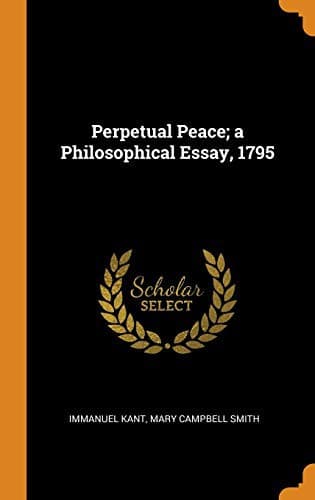
Perpetual Peace: A Philosophical EssayKant, Immanuel
PhilosophyPhilosophy
Perpetual Peace: A Philosophical Essay
Kant, Immanuel
Peace
the advantages of a high state of civilisation are not all negative.
The more highly developed the individuals who form a state, the more
highly developed is its consciousness of its obligations to other
nations. In the ignorance and barbarism of races lies the great
obstacle to a reign of law among states. Uncivilised states cannot
be conceived as members of a federation of Europe. First, the
perfect civil constitution according to right: then the federation of
these law-abiding Powers. This is the path which reason marks out.
The treatise on _Perpetual Peace_ seems to be in this respect more
practical than the _Idea for a Universal History_. But it matters
little which way we take it. The point of view is the same in both
cases: the end remains the development of man towards good, the order
of his steps in this direction is indifferent.
[55] See p. 107.
[56] See p. 120.
_The Political and Social Conditions of Kant’s Time._
The history of the human race, viewed as a whole, Kant regards
as the realisation of a hidden plan of nature to bring about a
political constitution internally and externally perfect—the only
condition under which the faculties of man can be fully developed.
Does experience support this theory? Kant thought that, to a certain
degree, it did. This conviction was not, however, a fruit of his
experience of citizenship in Prussia, an absolute dynastic state,
a military monarchy waging perpetual dynastic wars of the kind he
most hotly condemned. Kant had no feeling of love to Prussia,[57]
and little of a citizen’s patriotic pride, or even interest, in its
political achievements. This was partly because of his sympathy with
republican doctrines: partly due to his love of justice and peculiar
hatred of war,[58] a hatred based, no doubt, not less on principle
than on a close personal experience of the wretchedness it brings
with it. It was not the political and social conditions in which he
lived which fostered Kant’s love of liberty and gave him inspiration,
unless in the sense in which the mind reacts upon surrounding
influences. Looking beyond Prussia to America, in whose struggle
for independence he took a keen interest, and looking to France
where the old dynastic monarchy had been succeeded by a republican
state, Kant seemed to see the signs of a coming democratisation of
the old monarchical society of Europe. In this growing influence on
the state of the mass of the people who had everything to lose in
war and little to gain by victory, he saw the guarantee of a future
perpetual peace. Other forces too were at work to bring about this
consummation. There was a growing consciousness that war, this costly
means of settling a dispute, is not even a satisfactory method of
settlement. Hazardous and destructive in its effect, it is also
uncertain in its results. Victory is not always gain; it no longer
signifies a land to be plundered, a people to be sold to slavery. It
Public-domain text, read in full here on John Shaqi.
Reviews
Reviews
No reviews yet
Be the first to share your thoughts on this work.
Join the Discussion
Join the discussion
Sign in to leave a comment or review.
Sign InorCreate an account