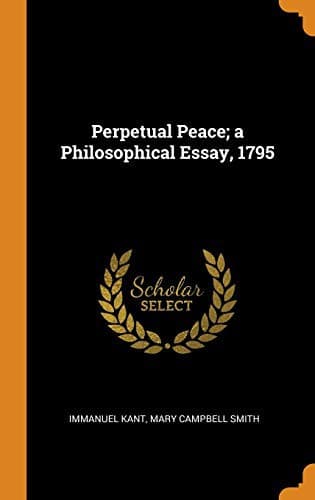
Perpetual Peace: A Philosophical EssayKant, Immanuel
PhilosophyPhilosophy
Perpetual Peace: A Philosophical Essay
Kant, Immanuel
Peace
(_a_) The intercourse of nations is to be confined to a right of
hospitality. (Art. 3.)[70] There is nothing new to us in this
assertion of a right of way. The right to free means of international
communication has in the last hundred years become a commonplace of
law. And the change has been brought about, as Kant anticipated,
not through an abstract respect for the idea of right, but through
the pressure of purely commercial interests. Since Kant’s time
the nations of Europe have all been more or less transformed from
agricultural to commercial states whose interests run mainly in the
same direction, whose existence and development depend necessarily
upon “conditions of universal hospitality.” Commerce depends upon
this freedom of international intercourse, and on commerce mainly
depends our hope of peace.
[70] See p. 137. The main principle involved in this passage
comes from Vattel (_op. cit._, II. Ch. viii. §§ 104, 105: Ch. ix.
§§ 123, 125). A sovereign, he says, cannot object to a stranger
entering his state who at the same time respects its laws. No one
can be quite deprived of the right of way which has been handed
down from the time when the whole earth was common to all men.
(_b_) The first Definitive Article[71] requires that the constitution
of every state should be republican. What Kant understands by this
term is that, in the state, law should rule above force and that
its constitution should be a representative one, guaranteeing
public justice and based on the freedom and equality of its members
and their mutual dependence on a common legislature. Kant’s demand
is independent of the _form_ of the government. A constitutional
monarchy like that of Prussia in the time of Frederick the Great,
who regarded himself as the first servant of the state and ruled
with the wisdom and forethought which the nation would have had
the right to demand from such an one—such a monarchy is not in
contradiction to the idea of a true republic. That the state should
have a constitution in accordance with the principles of right is
the essential point.[72] To make this possible, the law-giving
power must lie with the representatives of the people: there must be
a complete separation, such as Locke and Rousseau demand, between
the legislature and executive. Otherwise we have despotism. Hence,
while Kant admitted absolutism under certain conditions, he rejected
democracy where, in his opinion, the mass of the people was despot.
[71] See p. 120.
Public-domain text, read in full here on John Shaqi.
Reviews
Reviews
No reviews yet
Be the first to share your thoughts on this work.
Join the Discussion
Join the discussion
Sign in to leave a comment or review.
Sign InorCreate an account