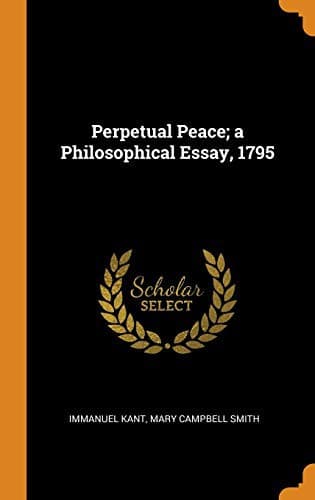
Perpetual Peace: A Philosophical Essay — John Shaqi
Perpetual Peace: A Philosophical EssayKant, Immanuel
PhilosophyPhilosophy
Perpetual Peace: A Philosophical Essay
Kant, Immanuel
Peace
Federation and federation alone can help out the programme
of the Peace Society. It cannot be pretended that it will do
everything. To state the worst at once, it will not prevent war.
Even the federations of the states of Germany and America, bound
together by ties of blood and language and, in the latter case, of
sentiment, were not strong enough within to keep out dissension and
disunion.[101] Wars would not cease, but they would become much less
frequent. “Why is there no longer war between England and Scotland?
Why did Prussian and Hanoverian fight side by side in 1870, though
they had fought against each other only four years before?... If
we wish to know how war is to cease, we should ask ourselves how it
_has_ ceased” (Professor D. G. Ritchie, _op. cit._, p. 169). Wars
between different grades of civilisation are bound to exist as long
as civilisation itself exists. The history of culture and of progress
has been more or less a history of war. A calm acceptance of this
position may mean to certain short-sighted, enthusiastic theorists
an impossible sacrifice of the ideal; but, the sacrifice once made,
we stand on a better footing with regard to at least one class of
arguments against a federation of the world. Such a union will lead,
it is said, to an equality in culture, a sameness of interests fatal
to progress; all struggle and conflict will be cast out of the
state itself; national characteristics and individuality will be
obliterated; the lamb and the wolf will lie down together: stagnation
will result, intellectual progress will be at an end, politics will
be no more, history will stand still. This is a sweeping assertion,
an alarming prophecy. But a little thought will assure us that there
is small cause for apprehension. There can be no such standstill,
no millennium in human affairs. A gradual smoothing down of sharply
accentuated national characteristics there might be: this is a result
which a freer, more friendly intercourse between nations would be
very likely to produce. But conflicting interests, keen rivalry
in their pursuit, difference of culture and natural aptitude, and
all or much of the individuality which language and literature,
historical and religious traditions, even climatic and physical
conditions produce are bound to survive until the coming of some more
overwhelming and far-spreading revolution than this. It would not
be well if it were otherwise, if those “unconscious and invisible
peculiarities” in which Fichte sees the hand of God and the guarantee
of a nation’s future dignity, virtue and merit should be swept away.
(_Reden an die deutsche Nation_,[102] 1807.) Nor is stagnation to be
feared. “Strife,” said the old philosopher, “is the father of all
things.” There can be no lasting peace in the processes of nature and
existence. It has been in the constant rivalry between classes within
themselves, and in the struggle for existence with other races that
Public-domain text, read in full here on John Shaqi.
Reviews
Reviews
No reviews yet
Be the first to share your thoughts on this work.
Join the Discussion
Join the discussion
Sign in to leave a comment or review.
Sign InorCreate an account