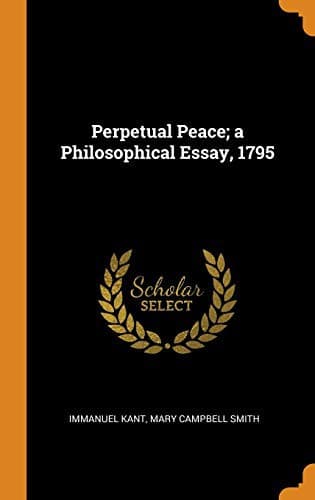
Perpetual Peace: A Philosophical EssayKant, Immanuel
PhilosophyPhilosophy
Perpetual Peace: A Philosophical Essay
Kant, Immanuel
Peace
[125] But see p. 136, where Kant seems to speak of a State of
nations as the ideal. Kant expresses himself, on this point, more
clearly in the _Rechtslehre_, Part. II. § 61:—“The natural state
of nations,” he says here, “like that of individual men, is a
condition which must be abandoned, in order that they may enter a
state regulated by law. Hence, before this can take place, every
right possessed by these nations and every external “mine” and
“thine” [_id est_, symbol of possession] which states acquire or
preserve through war are merely _provisional_, and can become
_peremptorily_ valid and constitute a true state of peace only
in a universal _union of states_, by a process analogous to that
through which a people becomes a state. Since, however, the too
great extension of such a State of nations over vast territories
must, in the long run, make the government of that union—and
therefore the protection of each of its members—impossible, a
multitude of such corporations will lead again to a state of war.
So that _perpetual peace_, the final goal of international law
as a whole, is really an impracticable idea [_eine unausführbare
Idee_]. The political principles, however, which are directed
towards this end, (that is to say, towards the establishment of
such unions of states as may serve as a continual approximation
to that ideal), are not impracticable; on the contrary, as this
approximation is required by duty and is therefore founded also
upon the rights of men and of states, these principles are,
without doubt, capable of practical realization.” [Tr.]
The attachment of savages to their lawless liberty, the fact
that they would rather be at hopeless variance with one another
than submit themselves to a legal authority constituted by
themselves, that they therefore prefer their senseless freedom to a
reason-governed liberty, is regarded by us with profound contempt as
barbarism and uncivilisation and the brutal degradation of humanity.
So one would think that civilised races, each formed into a state by
itself, must come out of such an abandoned condition as soon as they
possibly can. On the contrary, however, every state thinks rather
that its majesty (the “majesty” of a people is an absurd expression)
lies just in the very fact that it is subject to no external legal
authority; and the glory of the ruler consists in this, that, without
his requiring to expose himself to danger, thousands stand at his
command ready to let themselves be sacrificed for a matter of no
concern to them.[126] The difference between the savages of Europe
and those of America lies chiefly in this, that, while many tribes of
the latter have been entirely devoured by their enemies, Europeans
know a better way of using the vanquished than by eating them; and
they prefer to increase through them the number of their subjects,
and so the number of instruments at their command for still more
widely spread war.
Public-domain text, read in full here on John Shaqi.
Reviews
Reviews
No reviews yet
Be the first to share your thoughts on this work.
Elsewhere in the archive
Join the Discussion
Join the discussion
Sign in to leave a comment or review.
Sign InorCreate an account