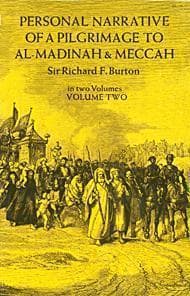
Personal Narrative of a Pilgrimage to Al-Madinah & Meccah — Volume 1Burton, Richard Francis, Sir
ReligionIslamic
Personal Narrative of a Pilgrimage to Al-Madinah & Meccah — Volume 1
Burton, Richard Francis, Sir
Arabian Peninsula -- Description and travel
This, however, is only the Koranic precept; in practice a
much less trustful spirit prevails.
[FN#8] Towards the end of the season, poor pilgrims are forwarded
gratis, by order of government. But, to make such liberality as
inexpensive as possible, the Pasha compels ship-owners to carry one
pilgrim per 9 ardebs (about 5 bushels each), in small, and 1 per 11 in
large vessels.
[FN#9] I was informed by a Prussian gentleman, holding an official
appointment under His Highness the Pasha, at Cairo, that 300,000 ardebs
of grain were annually exported from Kusayr to Jeddah. The rest is
brought down the Nile for consumption in Lower Egypt, and export to
Europe.
[FN#10] The account here offered to the reader was kindly supplied to
me by Henry Levick, Esq. (late Vice-Consul, and afterwards Post-master
at Suez), and it may be depended upon, as coming from a resident of 16
years' standing. All the passages marked with inverted commas are
extracts from a letter with which that gentleman favoured me. The
information is obsolete now, but it may be interesting as a specimen of
the things that were.
[FN#11] The rate of freight is at present (1853) about forty shillings
per ton-very near the same paid by the P. and O. Company for coals
carried from Newcastle via the Cape to Suez. Were the "Farzah"
abolished, freight to Jeddah would speedily fall to 15 or 16 shillings
per ton. Passengers from Suez to Jeddah are sometimes charged as much
as 6 or even 8 dollars for standing room-personal baggage forming
another pretext for extortion-and the higher orders of pilgrims,
occupying a small portion of the cabin, pay about 12 dollars. These
first and second class fares would speedily be reduced, by abolishing
protection, to 3 and 6 dollars. Note to Second Edition.-The "Farzah," I
may here observe, has been abolished by Sa'id Pasha since the
publication of these lines: the effects of "free trade" are exactly
what were predicted by Mr. Levick.
[FN#12] The principal trade from Suez is to Jeddah, Kusayr supplying
Yambu'. The latter place, however, imports from Suez wheat, beans,
cheese, biscuit, and other provisions for return pilgrims.
[FN#13] My friends were strenuous in their exertions for me to make
interest with Mr. West. In the first place, we should have paid less
for the whole of a privileged vessel, than we did for our wretched
quarters on the deck of the pilgrim-ship; and, secondly, we might have
touched at any port we pleased, so as to do a little business in the
way of commerce.
[FN#14] Afterwards called by Sir R. F. Burton the "Golden Wire."-ED.
[FN#15] For the "Sath," or poop, the sum paid by each was seven Riyals.
I was, therefore, notably cheated by Sa'ad the Demon. The unhappy women
in the "Kamrah," or cabin, bought suffocation at the rate of 6 dollars
each, as I was afterwards informed, and the third class, in the "Taht,"
or amidships and forward, contributed from 3 to 5 Riyals. But, as usua1
on these occasions, there was no prix fixe; every man was either
Public-domain text, read in full here on John Shaqi.
Reviews
Reviews
No reviews yet
Be the first to share your thoughts on this work.
Elsewhere in the archive
Join the Discussion
Join the discussion
Sign in to leave a comment or review.
Sign InorCreate an account