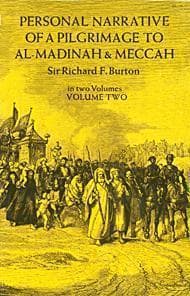
Personal Narrative of a Pilgrimage to Al-Madinah & Meccah — Volume 1Burton, Richard Francis, Sir
ReligionIslamic
Personal Narrative of a Pilgrimage to Al-Madinah & Meccah — Volume 1
Burton, Richard Francis, Sir
Arabian Peninsula -- Description and travel
overcharged or undercharged, according to his means or his necessities.
We had to purchase our own water, but the ship was to supply us with
fuel for cooking. We paid nothing extra for luggage, and we carried an
old Maghrabi woman gratis for good luck.
[FN#16] We were still at Suez, where we could do as we pleased. But
respectable Arabs in their own country, unlike Egyptians, are seldom to
be seen in the places of public resort. "Go to the coffee-house and
sing there!" is a reproach sometimes addressed to those who have a
habit of humming in decent society.
[FN#17] It was only my prestige as physician that persuaded my friend
to join me in these bathings. As a general rule, the Western Arabs
avoid cold water, from a belief that it causes fever. When Mr. C. Cole,
H.B.M.'s Vice-Consul, arrived at Jeddah, the people of the place,
seeing that he kept up his Indian habits, advised him strongly to drop
them. He refused; but unhappily he soon caught a fever, which confirmed
them all in their belief. When Arabs wish to cool the skin after a
journey, they wash with a kind of fuller's earth called "Tafl," or with
a thin paste of henna, and then anoint the body with oil or butter.
[FN#18] An incrementative form of the name "Fatimah," very common in
Egypt. Fatimah would mean a "weaner"-Fattumah, a "great weaner." By the
same barbarism Khadijah becomes "Khaddugah"; Aminah, "Ammunah"; and
Nafisah, "Naffusah," on the banks of the Nile.
[FN#19] The palmy days of the Egyptian husband, when he might use the
stick, the sword, or the sack with impunity, are, in civilised places
at least, now gone by. The wife has only to complain to the Kazi, or to
the governor, and she is certain of redress. This is right in the
abstract, but in practice it acts badly. The fair sex is so unruly in
this country, that strong measures are necessary to coerce it, and in
the arts of deceit men have here little or no chance against women.
[FN#20] The amount of settlement being, among Moslems as among
Christians, the test of a bride's value,-moral and physical,-it will
readily be understood that our demand was more facetious than
complimentary.
[FN#21] The term Misriyah (an Egyptian woman) means in Al-Hijaz and the
countries about it, a depraved character. Even the men own unwillingly
to being Egyptians, for the free-born never forget that the banks of
the Nile have for centuries been ruled by the slaves of slaves. "He
shall be called an Egyptian," is a denunciation which has been
strikingly fulfilled, though the country be no longer the "basest of
kingdoms."
[FN#22] In those days merchants depended solely upon the native trade
and the passage of pilgrims. The pecuniary advantage attending what is
called the Overland transit benefits chiefly the lowest orders,
camel-men, sailors, porters, and others of the same class. Sixteen
years ago the hire of a boat from the harbour to the roadstead was a
piastre and a half: now it is at least five.
Public-domain text, read in full here on John Shaqi.
Reviews
Reviews
No reviews yet
Be the first to share your thoughts on this work.
Elsewhere in the archive
Join the Discussion
Join the discussion
Sign in to leave a comment or review.
Sign InorCreate an account