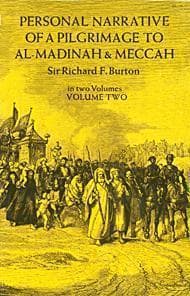
Personal Narrative of a Pilgrimage to Al-Madinah & Meccah — Volume 1 — John Shaqi
Personal Narrative of a Pilgrimage to Al-Madinah & Meccah — Volume 1Burton, Richard Francis, Sir
ReligionIslamic
Personal Narrative of a Pilgrimage to Al-Madinah & Meccah — Volume 1
Burton, Richard Francis, Sir
Arabian Peninsula -- Description and travel
but the most noble aspiration to the divine, innate in the human,
spirit. (Dabistan, vol. iii.)
[FN#14] [Greek text] "Quid novi fert Africa?" said the Romans. "In the
same season Fayoles, tetrarch of Numidia, sent from the land of Africa
to Grangousier, the most hideously great mare that was ever seen; for
you know well enough how it is said, that ‘Africa always is productive
of some new thing.'"
[FN#15] Alexandria, moreover, is an interesting place to Moslems, on
account of the prophecy that it will succeed to the honours of Meccah,
when the holy city falls into the hands of the infidel. In its turn
Alexandria will be followed by Kairawan (in the Regency of Tunis); and
this by Rashid or Rosetta, which last shall endure to the end of time.
[FN#16] A Persian as opposed to an Arab.
[FN#17] A priest, elder, chieftain, language-master, private-tutor,
&c., &c.
[FN#18] The Persians place the Prophet's tomb at Susan or Sus,
described by Ibn Haukal (p. 76). The readers of Ibn Batutah may think
it strange that the learned and pious traveller in his account of
Alexandria (chap. 2.) makes no allusion to the present holy deceased
that distinguish the city. All the saints are now clear forgotten. For
it is the fate of saints, like distinguished sinners, to die twice.
[FN#19] The Mandal is that form of Oriental divination which owes its
present celebrity in Europe to Mr. Lane. Both it and the magic mirror
are hackneyed subjects, but I have been tempted to a few words
concerning them in another part of these volumes. Meanwhile I request
the reader not to set me down as a mere charlatan; medicine in the East
is so essentially united with superstitious practices, that he who
would pass for an expert practitioner, must necessarily represent
himself an "adept."
[FN#20] Hence the origin, I believe, of the Chronothermal System, a
discovery which physic owes to my old friend, the late Dr. Samuel
Dickson.
[FN#21] The Persian "Mister." In future chapters the reader will see
the uncomfortable consequences of my having appeared in Egypt as a
Persian. Although I found out the mistake, and worked hard to correct
it, the bad name stuck to me; bazar reports fly quicker and hit harder
than newspaper paragraphs.
[FN#22] Arab Christians sometimes take the name of "Abdullah," servant
of Allah-"which," as a modern traveller observes, "all sects and
religions might be equally proud to adopt." The Moslem Prophet said,
"the names most approved of God are Abdullah, Abd-al-rahman (Slave of
the Compassionate), and such like."
[FN#23] "King in-the-name-of-Allah," a kind of Oriental
"Praise-God-Barebones." When a man appears as a Fakir or Darwaysh, he
casts off, in process of regeneration, together with other worldly
sloughs, his laical name for some brilliant coat of nomenclature rich
in religious promise.
[FN#24] A Murshid is one allowed to admit Murids or apprentices into
the order. As the form of the diploma conferred upon this occasion may
Public-domain text, read in full here on John Shaqi.
Reviews
Reviews
No reviews yet
Be the first to share your thoughts on this work.
Join the Discussion
Join the discussion
Sign in to leave a comment or review.
Sign InorCreate an account