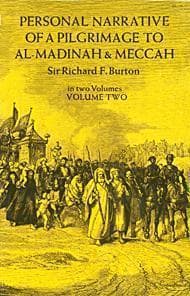
Personal Narrative of a Pilgrimage to Al-Madinah & Meccah — Volume 1Burton, Richard Francis, Sir
ReligionIslamic
Personal Narrative of a Pilgrimage to Al-Madinah & Meccah — Volume 1
Burton, Richard Francis, Sir
Arabian Peninsula -- Description and travel
has done wonders for the race that nurtured and brought to perfection
an idea spontaneous to their organisation. The world has yet to learn
that the admirable exotic will thrive amongst the country gentlemen of
Monomotapa or the ragged nobility of Al-Hijaz.[FN#29] And it requires
no prophetic eye to foresee the day when the Wahhabis or the Badawin,
rising en masse, will rid the land of its feeble conquerors.[FN#30]
Sa'ad, the Old Man of the Mountains, was described to me as a little
brown Badawi; contemptible in appearance, but remarkable for courage
and ready wit. He has for treachery a keen scent, which he requires to
keep in exercise. A blood feud with Abd al-Muttalib, the present Sharif
of Meccah, who slew his nephew, and the hostility of several Sultans,
has rendered his life eventful. He lost all his teeth by poison, which
would have killed him, had he not, after swallowing the potion,
corrected it by drinking off a large potfull of clarified butter. Since
that time he has lived entirely upon fruits, which he gathers for
himself, and
[p.260] coffee which he prepares with his own hands. In Sultan Mahmud's
time he received from Constantinople a gorgeous purse, which he was
told to open, as it contained something for his private inspection.
Suspecting treachery, he gave it for this purpose to a slave, bidding
him carry it to some distance; the bearer was shot by a pistol
cunningly fixed, like Rob Roy's, in the folds of the bag. Whether this
far-known story be "true or only well found," it is certain that Shaykh
Sa'ad now fears the Turks, even "when they bring gifts." The Sultan
sends, or is supposed to send him, presents of fine horses, robes of
honour, and a large quantity of grain. But the Shaykh, trusting to his
hills rather than to steeds, sells them; he gives away the dresses to
his slaves, and he distributes the grain amongst his clansmen. Of his
character, men, as usual, tell two tales: some praise his charity, and
call him the friend of the poor, as certainly as he is a foe to the
rich. Others, on the contrary, describe him as cruel, cold-blooded, and
notably, even among Arabs, revengeful and avaricious. The truth
probably lies between these two extremes, but I observed that those of
my companions who spoke most highly of the robber chief when at a
distance seemed to be in the sudori freddi whilst under the shadow of
his hills.
Public-domain text, read in full here on John Shaqi.
Reviews
Reviews
No reviews yet
Be the first to share your thoughts on this work.
Elsewhere in the archive
Join the Discussion
Join the discussion
Sign in to leave a comment or review.
Sign InorCreate an account