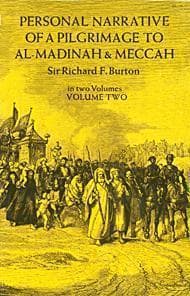
Personal Narrative of a Pilgrimage to Al-Madinah & Meccah — Volume 1Burton, Richard Francis, Sir
ReligionIslamic
Personal Narrative of a Pilgrimage to Al-Madinah & Meccah — Volume 1
Burton, Richard Francis, Sir
Arabian Peninsula -- Description and travel
Al-Hamra is the third station from Al-Madinah in the Darb Sultani, the
"Sultan's" or "High Road," the Westerly line leading to Meccah along
the sea-coast. When the robbers permit, the pilgrims prefer this route
on account of its superior climate, the facility of procuring water and
supplies, the vicinity of the sea, and the circumstance of its passing
through "Badr," the scene of the Prophet's principal military exploits
(A.H. 2). After mid-day, on the 21st July, when we had made up our
minds that Fate had determined we should halt at Al-Hamra, a caravan
arrived from Meccah; and the new travellers had interest to procure an
escort, and permission
[p.261] to proceed without delay towards Al-Madinah. The good news
filled us with joy. A little after four P.M. we urged our panting
camels over the fiery sands to join the Meccans, who were standing
ready for the march, on the other side of the torrent bed. An hour
afterwards we started in an Easterly direction.
My companions having found friends and relations in the Meccan
caravan,-the boy Mohammed's elder brother, about whom more anon, was of
the number,-were full of news and excitement. At sunset they prayed
with unction: even Sa'ad and Hamid had not the face to sit their camels
during the halt, when all around were washing, sanding
themselves,[FN#31] and busy with their devotions. We then ate our
suppers, remounted, and started once more. Shortly after night set in,
we came to a sudden halt. A dozen different reports rose to account for
this circumstance, which was occasioned by a band of Badawin, who had
manned a gorge, and sent forward a "parliamentary," ordering us
forthwith to stop. They at first demanded money to let us pass; but at
last, hearing that we were Sons of the Holy Cities, they granted us
transit on the sole condition that the military,-whom they, like Irish
peasants, hate and fear,-should return to whence they came. Upon this,
our escort, 200 men, wheeled their horses round and galloped back to
their barracks. We moved onwards, without, however, seeing any robbers;
my camel-man pointed out their haunts, and showed me a small bird
hovering over a place where he supposed water trickled from the rock.
The fellow had attempted a sneer at my expense when the fray was
impending. "Why don't you load your pistols, Effendi,"
[p.262] he cried, "and get out of your litter, and show fight?"
"Because," I replied as loudly, "in my country, when dogs run at us, we
thrash them with sticks." This stopped Mansur's mouth for a time, but
he and I were never friends. Like the lowest orders of Orientals, he
required to be ill-treated; gentleness and condescension he seemed to
consider a proof of cowardice or of imbecility. I began with kindness,
but was soon compelled to use hard words at first, and then threats,
which, though he heard them with frowns and mutterings, produced
manifest symptoms of improvement.
"Oignez vilain, il vous poindra!
Poignez vilain, il vous oindra!"
Public-domain text, read in full here on John Shaqi.
Reviews
Reviews
No reviews yet
Be the first to share your thoughts on this work.
Elsewhere in the archive
Join the Discussion
Join the discussion
Sign in to leave a comment or review.
Sign InorCreate an account