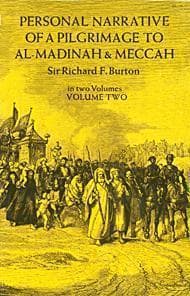
Personal Narrative of a Pilgrimage to Al-Madinah & Meccah — Volume 1Burton, Richard Francis, Sir
ReligionIslamic
Personal Narrative of a Pilgrimage to Al-Madinah & Meccah — Volume 1
Burton, Richard Francis, Sir
Arabian Peninsula -- Description and travel
says the old French proverb, and the axiom is more valuable in the East
even than in the West.
Our night's journey had no other incident. We travelled over rising
ground with the moon full in our faces; and, about midnight, we passed
through another long straggling line of villages, called
Jadaydah,[FN#32] or Al-Khayf.[FN#33] The principal part of it lies on
the left of the road going to Al-Madinah; it has a fort like that of
Al-Hamra, springs of tolerable drinking water, a Nakhil or date-ground,
and a celebrated (dead) saint, Abd al-Rahim al-Burai. A little beyond
it lies the Bughaz[FN#34] or defile, where in A.D. 1811 Tussun Bey and
his 8000 Turks were totally defeated by 25,000 Harbi Badawin and
Wahhabis.[FN#35]
[p.263] This is a famous attacking-point of the Beni-Harb. In former
times both Jazzar Pasha, the celebrated "butcher" of Syria, and
Abdullah Pasha of Damascus, were baffled at the gorge of
Jadaydah[FN#36]; and this year the commander of the Syrian caravan,
afraid of risking an attack at a place so ill-omened, avoided it by
marching upon Meccah via the Desert road of Nijd. At four A.M., having
travelled about twenty-four miles due East, we encamped at Bir Abbas.
[FN#1] Alluding to the celebrated mountain, the "Hindu-kush," whence
the Afghans sallied forth to lay waste India.
[FN#2] Throughout this work I have estimated the pace of a Hijazi
camel, laden and walking in caravan line, under ordinary circumstances,
at two geographical miles an hour. A sandy plain or a rocky pass might
make a difference of half a mile each way, but not more.
[FN#3] See Chap. VIII., page 152, note 1, ante.
[FN#4] The reader must be warned that these little villages in Arabia,
as in Sind and Baluchistan, are continually changing their names,
whilst the larger settlements always retain the same. The traveller,
too, must beware of writing down the first answer he receives; in one
of our maps a village on the Euphrates is gravely named "M'adri,"
("Don't know").
[FN#5] Here called Samn, the Indian ghee.
[FN#6] The "Kahk" in this country is a light and pleasant bread made of
ground wheat, kneaded with milk, leavened with sour bean flour, and
finally baked in an oven, not, as usual, in the East, upon an iron
plate. The Kahk of Egypt is a kind of cake.
[FN#7] Stale unleavened bread is much relished by Easterns, who say
that keeping it on journeys makes it sweet. To prevent its becoming
mouldy, they cut it up into little bits, and, at the risk of hardening
it to the consistence of wood, they dry it by exposure to the air.
[FN#8] This Akit has different names in all parts of Arabia; even in
Al-Hijaz it is known by the name of Mazir, as well as, "Igt," (the
corruption of Akit). When very sour, it is called "Saribah," and when
dried, without boiling, "Jamidah." The Arabs make it by evaporating the
serous part of the milk; the remainder is then formed into cakes or
lumps with the hand, and spread upon hair cloth to dry. They eat it
Public-domain text, read in full here on John Shaqi.
Reviews
Reviews
No reviews yet
Be the first to share your thoughts on this work.
Elsewhere in the archive
Join the Discussion
Join the discussion
Sign in to leave a comment or review.
Sign InorCreate an account