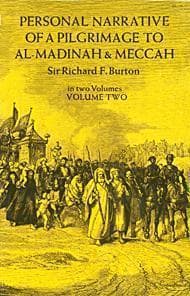
Personal Narrative of a Pilgrimage to Al-Madinah & Meccah — Volume 1Burton, Richard Francis, Sir
ReligionIslamic
Personal Narrative of a Pilgrimage to Al-Madinah & Meccah — Volume 1
Burton, Richard Francis, Sir
Arabian Peninsula -- Description and travel
[p.85]the fine air of the Desert, inspiriting as a cordial, when
star-light and dew-mists diversified a scene, which, by day, is one
broad sea of yellow loam with billows of chalk rock, thinly covered by
a film-like spray of sand surging and floating in the fiery wind.
There, within a mile of crowded life, all is desolate; the town walls
seem crumbling to decay, the hovels are tenantless, and the paths
untrodden; behind you lies the Wild, before you, the thousand
tomb-stones, ghastly in their whiteness; while beyond them the tall
dark forms of the Mamluk Soldans' towers rise from the low and hollow
ground like the spirits of kings guarding ghostly subjects in the
Shadowy Realm. Nor less weird than the scene are the sounds!-the
hyaena's laugh, the howl of the wild dog, and the screech of the
low-flying owl. Or we spent the evening at some Takiyah[FN#23]
(Darwayshes' Oratory), generally preferring that called the "Gulshani,"
near the Muayyid Mosque outside the Mutawalli's saintly door. There is
nothing attractive in its appearance. You mount a flight of ragged
steps, and enter a low verandah enclosing an open stuccoed terrace,
where stands the holy man's domed tomb: the two stories contain small
dark rooms in which the Darwayshes dwell, and the ground-floor doors
open into the
[p.86]verandah. During the fast-month, Zikrs[FN#24] are rarely
performed in the Takiyahs: the inmates pray there in congregations, or
they sit conversing upon benches in the shade. And a curious medley of
men they are, composed of the choicest vagabonds from every nation of
Al-Islam. Beyond this I must not describe the Takiyah or the doings
there, for the "path" of the Darwaysh may not be trodden by feet
profane.
Curious to see something of my old friends the Persians, I called with
Haji Wali upon one Mirza Husayn, who by virtue of his dignity as
"Shahbandar[FN#25]" (he calls himself "Consul-General"), ranks with the
dozen little quasi-diplomatic kings of Cairo. He suspends over his
lofty gate a sign-board in which the Lion and the Sun (Iran's proud
ensign) are by some Egyptian limner's art metamorphosed into a
preternatural tabby cat grasping a scimitar, with the jolly fat face of
a "gay" young lady, curls and all complete, resting fondly upon her
pet's concave back. This high dignitary's reception room was a
court-yard sub dio: fronting the door were benches and cushions
composing the Sadr or high place, with the parallel rows of Diwans
spread down the less dignified sides, and a line of naked boards, the
lowest seats, ranged along the door-wall. In the middle stood three
little tables supporting three huge lanterns-as is their size so is the
owner's dignity-each of which contained three of the largest spermaceti
candles.
Public-domain text, read in full here on John Shaqi.
Reviews
Reviews
No reviews yet
Be the first to share your thoughts on this work.
Elsewhere in the archive
Join the Discussion
Join the discussion
Sign in to leave a comment or review.
Sign InorCreate an account