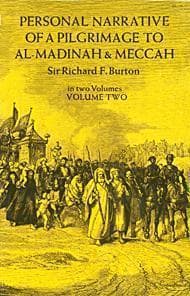
Personal Narrative of a Pilgrimage to Al-Madinah & Meccah — Volume 1Burton, Richard Francis, Sir
ReligionIslamic
Personal Narrative of a Pilgrimage to Al-Madinah & Meccah — Volume 1
Burton, Richard Francis, Sir
Arabian Peninsula -- Description and travel
The Haji and I entering took our seats upon the side benches with
humility, and exchanged salutations with the great man on the Sadr.
When the Darbar or levee was full, in stalked the Mirza, and all arose
as he calmly divested himself of his shoes; and with all due
[p.87]solemnity ascended his proper cushion. He is a short, thin man
about thirty-five, with regular features and the usual preposterous
lamb-skin cap and beard, two peaked black cones at least four feet in
length, measured from the tips, resting on a slender basement of pale
yellow face. After a quarter of an hour of ceremonies, polite
mutterings and low bendings with the right hand on the left breast, the
Mirza's pipe was handed to him first, in token of his dignity-at
Teheran he was probably an under-clerk in some government office. In
due time we were all served with Kaliuns[FN#26] (Persian hookahs) and
coffee by the servants, who made royal conges whenever they passed the
great man; and more than once the janissary, in dignity of belt and
crooked sabre, entered the court to quicken our awe.
The conversation was the usual Oriental thing. It is, for instance,
understood that you have seen strange things in strange lands.
"Voyaging-is-victory," quotes the Mirza; the quotation is a hackneyed
one, but it steps forth majestic as to pause and emphasis.
"Verily," you reply with equal ponderousness of pronunciation and
novelty of citation, "in leaving home one learns life, yet a journey is
a bit of Jahannam."
Or if you are a physician the "lieu commun" will be,
"Little-learn'd doctors the body destroy:
Little-learn'd parsons the soul destroy."
To which you will make answer, if you would pass for a man of belles
lettres, by the well-known lines,
"Of a truth, the physician hath power with drugs,
Which, long as the patient hath life, may relieve him;
But the tale of our days being duly told,
The doctor is daft, and his drugs deceive him."
After sitting there with dignity, like the rest of the guests, I took
my leave, delighted with the truly Persian
[p.88]"apparatus" of the scene. The Mirza, having no salary, lives by
fees extorted from his subjects, who pay rather than lack protection;
and his dragoman for a counter-fee will sell their interests
shamelessly. He is a hidalgo of blue blood in pride, pompousness and
poverty. There is not a sheet of writing-paper in the "Consulate"-when
they want one a farthing is sent to the grocer's-yet the Consul drives
out in an old carriage with four outriders, two tall-capped men
preceding and two following the crazy vehicle. And the Egyptians laugh
heartily at this display, being accustomed by Mohammed Ali to consider
all such parade obsolete.
Public-domain text, read in full here on John Shaqi.
Reviews
Reviews
No reviews yet
Be the first to share your thoughts on this work.
Elsewhere in the archive
Join the Discussion
Join the discussion
Sign in to leave a comment or review.
Sign InorCreate an account