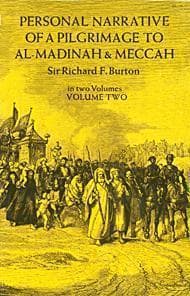
Personal Narrative of a Pilgrimage to Al-Madinah & Meccah — Volume 1Burton, Richard Francis, Sir
ReligionIslamic
Personal Narrative of a Pilgrimage to Al-Madinah & Meccah — Volume 1
Burton, Richard Francis, Sir
Arabian Peninsula -- Description and travel
[FN#1] Of course all quarrelling, abuse, and evil words are strictly
forbidden to the Moslem during Ramazan. If one believer insult another,
the latter should repeat "I am fasting" three times before venturing
himself to reply. Such is the wise law. But human nature in Egypt, as
elsewhere, is always ready to sacrifice the spirit to the letter,
rigidly to obey the physical part of an ordinance, and to cast away the
moral, as if it were the husk and not the kernel.
[FN#2] Allah opens (the door of daily bread) is a polite way of
informing a man that you and he are not likely to do business; in other
words, that you are not in want of his money.
[FN#3] The Sufrah is a piece of leather well tanned, and generally of a
yellow colour, bordered with black. It is circular, has a few small
pouches for knives or spoons, and, by means of a thong run through
rings in the periphery, can be readily converted into a bag for
carrying provisions on a journey. Figuratively it is used for the meal
itself. "Sufrah hazir" means that dinner is upon the table.
[FN#4] The Salam at this hour of the morning is confined to the
devotions of Ramazan. The curious reader may consult Lane's Modern
Egyptians, chap. 25, for a long and accurate interpretation of these
words.
[FN#5] The summons to prayer.
[FN#6] In the Mohammedan church every act of devotion must be preceded
by what is called its Niyat, or purpose. This intention must be either
mentally conceived, or, as the more general rule is, audibly expressed.
For instance, the worshipper will begin with "I purpose to pray the
four-bows of mid-day prayer to Allah the Almighty," and then he will
proceed to the act of worship. Moslems of the Shafe'i faith must
perform the Niyat of fasting every night for the ensuing day; the
Malikis, on the other hand, "purpose" abstinence but once for the
thirty days of Ramazan. Lane tells a pleasant tale of a thief in the
Mosque saying, "I purpose (before prayer) to carry off this nice pair
of new shoes!"
[FN#7] Many go to sleep immediately after the Imsak, or about a quarter
of an hour before the dawn prayer, and do not perform their morning
devotions till they awake. But this is not, strictly speaking, correct.
[FN#8] When the late Pasha of Egypt (H.H. Abbas Hilmi) came to power,
he built a large pile of palace close outside the walls of Cairo, on
the direction of Suez, and induced his courtiers to follow his example.
This was done readily enough, for Asiatics, like Europeans, enjoy the
fine air of the desert after the rank atmosphere of towns and cities.
If the successor of His Highness does not follow the usual Oriental
method of wiping away all vestiges of the predecessor, except his
grave, there will be, at no distant period, a second Cairo on the site
of the Abbasiyah.
[FN#9] One of our wants is a history of the bell and its succedanai.
Strict Moslems have an aversion to all modifications of this
instrument, striking clocks, gongs, &c., because they were considered
Public-domain text, read in full here on John Shaqi.
Reviews
Reviews
No reviews yet
Be the first to share your thoughts on this work.
Elsewhere in the archive
Join the Discussion
Join the discussion
Sign in to leave a comment or review.
Sign InorCreate an account