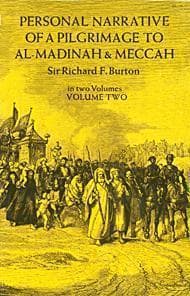
Personal Narrative of a Pilgrimage to Al-Madinah & Meccah — Volume 1Burton, Richard Francis, Sir
ReligionIslamic
Personal Narrative of a Pilgrimage to Al-Madinah & Meccah — Volume 1
Burton, Richard Francis, Sir
Arabian Peninsula -- Description and travel
by the Prophet peculiar to the devotions of Christians. He, therefore,
instituted the Azan, or call to prayer, and his followers still clap
their hands when we should ring for a servant. The symbolical meaning
of the bell, as shown in the sistrum of Isis, seems to be the movement
and mixture of the elements, which is denoted by clattering noise.
"Hence," observes a learned antiquary, "the ringing of bells and
clattering of plates of metal were used in all lustrations, sacrifices,
&c." We find them amongst the Jews, worn by the high priest; the Greeks
attached them to images of Priapus, and the Buddhists of Thibet still
use them in their worship, as do the Catholics of Rome when elevating
the Host.
[FN#10] Al-Ghada is the early dinner: Al-Asha, the supper, eaten
shortly after sunset. (See Lane's Modern Egyptians, Chap. 5.)
[FN#11] Extra prayers repeated in the month of Ramazan. (Lane, Chap.
25, "Tarawih.") They take about an hour, consisting of 23 prostrations,
with the Salam (or blessing on the Prophet) after every second
prostration.
[FN#12] The Shisha, or Egyptian and Syrian water-pipe, is too well
known to require any description. It is filled with a kind of tobacco
called Tumbak, for which see Chap. 4 of this Volume.
[FN#13] Strangers often wonder to see a kind of cemetery let into a
dwelling-house in a crowded street. The reason is, that some obstinate
saint has insisted upon being buried there, by the simple process of
weighing so heavily in his bier, that the bearers have been obliged to
place him on the pavement. Of course, no good Moslem would object to
have his ground floor occupied by the corpse of a holy man. The reader
will not forget, that in Europe statues have the whims which dead
bodies exhibit in Egypt. So, according to the Abbe Marche, the little
statue of Our Lady, lately found in the forest of Pennacom, "became,
notwithstanding her small size, heavy as a mountain, and would not
consent to be removed by any one but the chaplain of the chateau."
[FN#14] Europeans compare "Kara Gyuz" to our Chinese shadows. He is the
Turkish "Punch," and his pleasantries may remind the traveller of what
he has read concerning the Mines and Fescennine performances of the
Romans. On more than one occasion, Kara Gyuz has been reported to the
police for scandalously jibing and deriding consuls, Frank merchants,
and even Turkish dignitaries.
[FN#15] Mohammed Ali drained and planted the Azbakiyah, which, before
his day, was covered with water and mud long after the inundation had
ceased. The Egyptians extract a perfume, an aphrodisiac, which they
call "Fitnah," from this kind of Acacia.
[FN#16] All "Agapemones" are at this time suppressed, by order of His
Highness (Abbas Pasha), whose august mother occasionally insisted upon
banishing whole colleges of Ambubaiae to Upper Egypt. As might be
expected, this proceeding had a most injurious effect upon the morals
of society. I was once at Cairo during the ruler's absence on a tour up
Public-domain text, read in full here on John Shaqi.
Reviews
Reviews
No reviews yet
Be the first to share your thoughts on this work.
Elsewhere in the archive
Join the Discussion
Join the discussion
Sign in to leave a comment or review.
Sign InorCreate an account