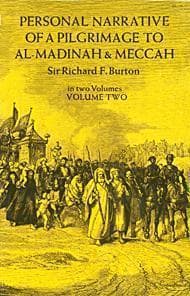
Personal Narrative of a Pilgrimage to Al-Madinah & Meccah — Volume 1Burton, Richard Francis, Sir
ReligionIslamic
Personal Narrative of a Pilgrimage to Al-Madinah & Meccah — Volume 1
Burton, Richard Francis, Sir
Arabian Peninsula -- Description and travel
Next in date to the Taylun Mosque is that of the Sultan al-Hakim, third
Caliph of the Fatimites, and founder of the Druze mysteries. The
minarets are remarkable in shape, as well as size: they are unprovided
with the usual outer gallery, they are based upon a cube of masonry,
and they are pierced above with apertures apparently meaningless. A
learned Cairene informed me that these spires were devised by the
eccentric monarch to disperse, like large censers, fragrant smoke over
the city during the hours of prayer. The Azhar and Hasanayn[FN#14]
Mosques are simple and artless piles, celebrated for sanctity, but
remarkable for nothing save ugliness. Few buildings, however, are
statelier in appearance,
[p.98]or give a nobler idea of both founder and architect than that
which bears Sultan Hasan's name. The stranger stands awe-struck before
walls high towering without a single break, a hypaethral court severe
in masculine beauty, a gateway that might suit the palace of the
Titans, and a lofty minaret of massive grandeur. This Mosque (finished
about A.D. 1363), with its fortress aspect, owns no more relationship
to the efforts of a later age than does Canterbury Cathedral to an
Anglo-Indian "Gothic." For dignified beauty and refined taste, the
Mosque and tomb of Kaid Bey and the other Mamluk kings are admirable.
Even in their present state, picturesqueness presides over decay, and
the traveller has seldom seen aught more striking than the rich light
of the stained glass pouring through the first shades of evening upon
the marble floor.
The modern Mosques must be visited to see Egyptian architecture in its
decline and fall. That of Sittna Zaynab (our Lady Zaynab), founded by
Murad Bey, the Mamluk, and interrupted by the French invasion, shows,
even in its completion, some lingering traces of taste. But nothing can
be more offensive than the building which every tourist flogs donkey in
his hurry to see-old Mohammed Ali's "Folly" in the citadel. Its Greek
architect has toiled to caricature a Mosque to emulate the glories of
our English "Oriental Pavilion." Outside, as Monckton Milnes sings,
"The shining minarets, thin and high,"
are so thin, so high above the lumpy domes, that they
Public-domain text, read in full here on John Shaqi.
Reviews
Reviews
No reviews yet
Be the first to share your thoughts on this work.
Elsewhere in the archive
Join the Discussion
Join the discussion
Sign in to leave a comment or review.
Sign InorCreate an account