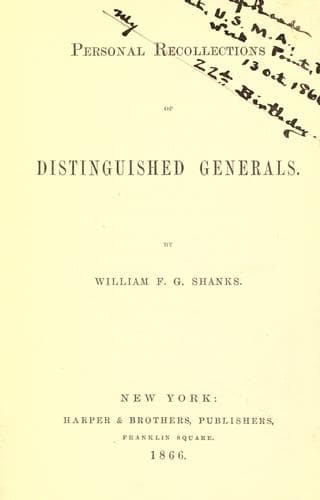
Personal Recollections of Distinguished GeneralsShanks, William Franklin Gore
History
Personal Recollections of Distinguished Generals
Shanks, William Franklin Gore
Generals -- United States; United States -- History -- Civil War, 1861-1865 -- Biography
A small force under General Osterhaus was ordered to make a feint upon
the enemy's rifle-pits at the point (or "nose," as Rosecrans calls
it) of the mountain, while with Geary, and Ireland, and Crufts, and
Whitaker, General Hooker moved up the valley west of the mountain until
a mile in rear of the enemy's position; the troops then ascended the
side of the range until the head of the column reached the palisades
which crown the mountain, and formed in line of battle at right angles
with them; they then marched forward as Osterhaus made a sharp attack
as a feint, and, by taking the rebel works in flank and rear, secured
about thirteen hundred prisoners. The enemy fled around the "nose" of
the mountain, closely pursued, to a position on the opposite side,
where Hooker again attacked. After one or two desperate efforts the
rebel works were carried, but it was at such a late hour (midnight)
that it was impossible to dislodge them from the Summertown road, a
route by which they evacuated during the night. Hooker made a great
reputation by his unique plan, and the vigor with which he executed it.
The battle on the other parts of the line were suspended for that day,
and Hooker on the mountain became the "observed of all observers." The
troops in the valley watched him and his Titans with equal admiration
and astonishment; astonishment at the success attained, and admiration
of the daring displayed. When our troops turned the point of the
mountain, taking the rebels in rear, capturing many and pursuing the
rest rapidly, the troops in the Valley of Chattanooga cheered them
repeatedly. As the lines of Hooker would advance after nightfall,
those in Chattanooga and the valley could see the fires built by the
reserves springing up and locating the advancing columns. As each line
became developed by these fires, those on the mountain could plainly
hear the loud cheers of their comrades below. One of the expressions
used by a private who was watching the fires from Orchard Knob grew
at once into the dignity of a camp proverb. On seeing the line of
camp-fires advanced beyond the last line of rifle-pits of the enemy, a
soldier in General Wood's command sprang up from his reclining position
on Orchard Knob and exclaimed,
"Look at old Hooker: don't he fight for 'keeps?'"
"Fighting for keeps" is army slang, and signifies fighting in deadly
earnest.
Public-domain text, read in full here on John Shaqi.
Reviews
Reviews
No reviews yet
Be the first to share your thoughts on this work.
Elsewhere in the archive
Join the Discussion
Join the discussion
Sign in to leave a comment or review.
Sign InorCreate an account