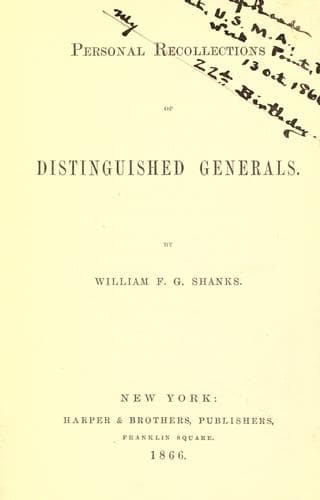
Personal Recollections of Distinguished GeneralsShanks, William Franklin Gore
History
Personal Recollections of Distinguished Generals
Shanks, William Franklin Gore
Generals -- United States; United States -- History -- Civil War, 1861-1865 -- Biography
Those who remained in Chattanooga described this combat as the most
magnificent one of the grand panorama of war which the various battles
of Chattanooga proved to be. General Meigs has graphically described
it at a moment when it was just dark enough to see the flash of the
muskets, and still light enough to distinguish the general outline of
the contending masses. The mountain was lit up by the fires of the
men in the second line, and the flash of the musketry and artillery.
An unearthly noise rose from the mountain, as if the old monster was
groaning with the punishment the pigmy combatants inflicted upon him as
well as upon each other, and during it all the great guns on the summit
continued, as in rage, to bellow defiance at the smaller guns in our
forts on the other side of the river, which, with lighter tone and more
rapidly, as if mocking the imbecility of its giant enemy, continued to
fire till the day roared itself into darkness.
General M. C. Meigs has given the combat its name of the "battle above
the clouds." It is true that Hooker fought above the clouds, but more
than this, he manufactured the clouds that he might fight above them.
During the night before the engagement a slight, misty rain had fallen,
and when the sun rose, cold and dull, next morning, a fog hung over
the river and enveloped the mountain, serving as a convenient mask to
Hooker's movements. As the day advanced, however, the fog began to
lift, and was fast disappearing, when the battle on the west side of
the mountain began to rage heavily. Then the smoke of Hooker's musketry
and artillery began to mingle with the mist and clouds; they grew heavy
again, and settled down close upon the mountain, so that at one time
the clouds thus formed hid the contending forces from the view of those
in the valley, and Hooker literally fought the battle above clouds of
his own making.
The "inspiring presence" with which Hooker is endowed, and to which I
have alluded, has had many illustrations. McClellan, with whom Hooker
was no favorite, acknowledged that the loss of Hooker's presence by
wounds, during the battle of Antietam, cost him many valuable fruits
of that conflict. While such an acknowledgment is disgraceful to
McClellan, who could thus admit that the absence of one corps commander
out of five could lose him a battle, it is highly complimentary to
Hooker, who appears, by the way, to have been the only officer at
Antietam who was fighting for any definite object, any vital or
key-point of the field.
Public-domain text, read in full here on John Shaqi.
Reviews
Reviews
No reviews yet
Be the first to share your thoughts on this work.
Elsewhere in the archive
Join the Discussion
Join the discussion
Sign in to leave a comment or review.
Sign InorCreate an account