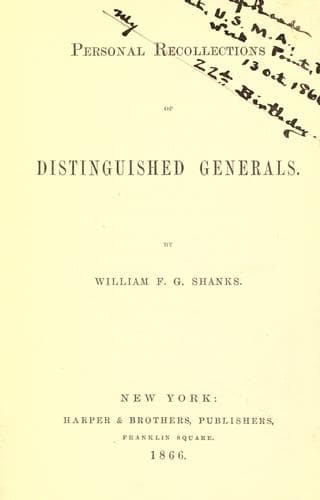
Personal Recollections of Distinguished GeneralsShanks, William Franklin Gore
History
Personal Recollections of Distinguished Generals
Shanks, William Franklin Gore
Generals -- United States; United States -- History -- Civil War, 1861-1865 -- Biography
Criticism forced the arbitrary Czar of Russia to abandon
the chief command of his army in the face of Napoleon's invasion of
1812, and turn over the command to a general who was not one of his
favorites. Hooker was, indeed, the only genuine military critic which
the war produced. Sherman occasionally indulged in critiques, but his
temper interfered with his judgment, and made his criticism as absurd
as vain. Fremont was merely a critic without being a general, and
found fault for the love of fault-finding. General Meigs, who also
tried his hand at criticism, was simply good-natured, not critical.
Cluseret and Gurowski were simply Bohemians, and Assistant Secretary of
War Dana won reputation only as "Secretary Stanton's spy."
The candor of Hooker's criticisms make them highly palatable. One
naturally admires the decision which marks them, and, though some may
consider his reasonings incorrect and his deductions unjust, they
must enjoy the perfect independence with which they are uttered.
His criticism on the battle of Bull Run first brought him to the
consideration of Mr. Lincoln, who read characters at a glance. His
famous criticism on McClellan, in which he did not hesitate (he never
hesitates either to censure or to fight) to attribute the failure
of the Peninsular campaign to "the want of generalship on the part
of our commander," gave him more publicity than his early battles.
The late President used to remark that he had never had occasion to
change the favorable opinion which he formed of Hooker on hearing
his criticism on the battle of Bull Run. The criticism on McClellan
indicates the character of the critic as that of a quick, resolute,
decided man, ready to take all responsibilities. The character has
been fully established by Hooker since he uttered that remarkably free
criticism. Hooker's opinion of McClellan has been attributed to envy
of the latter's position, but I think that he formed his conclusions
of the man long before the war of the rebellion. A circumstance which
happened during the Mexican War gave him his idea of McClellan, and
is so admirable an illustration of McClellan's character that I am
tempted to relate it here. Attached to Pillow's head-quarters, where
Hooker was chief of staff, was a young American, since celebrated as
an artist. He had long been resident in Mexico; was imprisoned on the
approach of our forces to the city, but managed to escape and reach our
army. Here he volunteered to act as interpreter to General Pillow, and
accompanied the army in this capacity through the rest of the campaign.
One day, while encamped in the city after its capture, Captain Hooker
requested the artist to make a drawing of a very superior piece of
artillery captured during the assault. It happened that this gun was in
the camp of a company of sappers and miners, and thither he repaired
to make the sketch. On going to the company head-quarters, he found
Gustavus Smith, the captain, and Callender, the first lieutenant of
Public-domain text, read in full here on John Shaqi.
Reviews
Reviews
No reviews yet
Be the first to share your thoughts on this work.
Elsewhere in the archive
Join the Discussion
Join the discussion
Sign in to leave a comment or review.
Sign InorCreate an account