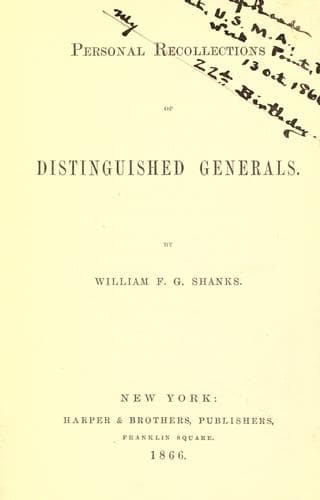
Personal Recollections of Distinguished GeneralsShanks, William Franklin Gore
History
Personal Recollections of Distinguished Generals
Shanks, William Franklin Gore
Generals -- United States; United States -- History -- Civil War, 1861-1865 -- Biography
The well-known effect of Sheridan's presence at Cedar Creek was not
more remarkable in restoring the morale of his army than was that
of Hooker at Peach-tree Creek, Georgia, in retrieving the disaster
which was there threatened. The Army of the Cumberland was surprised
at that point on the 20th of July, while on the march, and, being
vigorously attacked, was in great danger of being routed. It was a
well-known fact that the presence of Hooker every where along the line
of the threatened and almost defeated army kept the men in line, at
the work, and finally saved the day. Were it within the purpose of
this sketch to do so, no better illustration of the fighting general
could be given than a detailed account of this battle, in which Hooker
was the central--only figure. The country is as much indebted to him
personally for the victory as to Sheridan for Cedar Creek, Rousseau for
Perryville, or Thomas for Chickamauga.
Hooker is "his own worst enemy"--not in a common and vulgar acceptance
of that term, now universally applied to those who indulge their
appetite at the expense of the brain. His weakness is not of the vulgar
order, but has been the disease of great minds immemorial. His great
crime against weak humanity lies in the fact that he was born a critic.
Iago was not more positively critical than Hooker, though the latter
is not necessarily "nothing if not critical," as was Othello's evil
genius. Hooker can not resist the temptation to criticise; and, being
unable to appreciate that questionable code of morality in which policy
dictates that the truth is not always to be spoken, he has made himself
life-long enemies. He can attribute with perfect justice every failure
of his life to that one "weakness of the noble mind." It accelerated
his retirement from the service in 1853; it originated the difficulties
which nearly prevented his re-entry into the service in 1861; it
retarded his promotion, lay at the root of all his difficulties as
commander of the Army of the Potomac, made enemies of his subordinates,
and defeated his every plan, and at last forced him to resign command
of the army. It nearly defeated his every effort to regain a command.
It cost him many difficulties in the event, and finally forced him to
retire from active command under Sherman just as the war was being
wound up with the grand _crescendo_ movement of Grant. He was bitterly
assailed by the press, and persecuted by fellow-officers for his
various criticisms, and even accused of insubordination by men who
did not know that from time immemorial the orders of generals have
been freely criticised by subordinates, who did not fail to obey them,
however. Diogenes was not the only critic of Alexander the Great.
Napoleon would have suffered even more than McClellan from criticism
if he had been as poor a soldier, for McClellan had but one honest
critic, Hooker, and all of Napoleon's marshals frequently criticised
his movements.
Public-domain text, read in full here on John Shaqi.
Reviews
Reviews
No reviews yet
Be the first to share your thoughts on this work.
Elsewhere in the archive
Join the Discussion
Join the discussion
Sign in to leave a comment or review.
Sign InorCreate an account