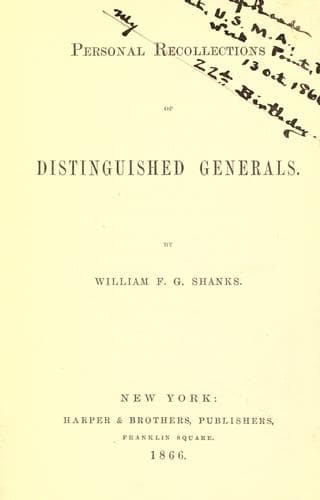
Personal Recollections of Distinguished GeneralsShanks, William Franklin Gore
History
Personal Recollections of Distinguished Generals
Shanks, William Franklin Gore
Generals -- United States; United States -- History -- Civil War, 1861-1865 -- Biography
Returning to Kentucky in 1849, Rousseau was one of the few of her sons
who were prepared to second or adopt the views then agitated by Henry
Clay in regard to emancipating slaves. In 1855, when "Know-Nothingism"
had swallowed up his old party--the Whig--and held temporarily a great
majority in his city, county, and state, Rousseau became the leader of
the small minority which rejected the false doctrines of the "American"
party. His bitter denunciation of its practices, its tendencies to
mob violence, and his persistent opposition to its encroachments on
individual rights, nearly cost him his life at the hands of a mob who
attacked him while defending a German in the act of depositing his
vote. He was shot through the abdomen, and confined for two months to
his bed, but had the satisfaction to know, when well again, that the
party he had fought almost single-handed had no longer an organized
existence. He was also instrumental, in 1855, in saving two of the
Catholic churches of Louisville from destruction at the hands of a
mob of Know-Nothings, and gained in popularity with both parties,
when the passion and excitement of the time had passed away, by these
exhibitions of his great courage and sense of right and justice.
It was not merely, however, through the political excitement of the
day that Rousseau won his popularity and established his character.
For many years past--for at least two generations before the war--the
courts of Kentucky have been noted for the many important and exciting
criminal trials which have come up in them, and no bar presented finer
opportunities for a young criminal lawyer. From the time of Rousseau's
return to Kentucky in 1849 to the period when he went into the army
in 1861, no important criminal case was tried in the Kentucky courts
in which he did not figure on one side or the other. In 1843, the old
system of pleading in the common law courts of England, as it existed
before it had been clipped and modified by legislation, was in vogue
at the Indiana bar, and on his advent in that state Rousseau soon
found that no lawyer could practice respectably there without special
pleading. A lawyer who was not a special pleader would in those days
frequently find his case and himself thrown out of court, without
exactly understanding how it was done. He therefore studied special
pleading as a system in itself, taking the old English authors on the
subject, and, after a few years' hard study and practice, soon made
himself one of the best special pleaders in the West. When he returned
to Kentucky, this system, not so thoroughly in use there, gave him
several triumphs, which at once established his character and gave
him plenty of practice. As a jury lawyer Rousseau has had no rival in
his district since 1855; and the late Attorney General of the United
States, James Speed, acknowledges himself indebted to Rousseau for
several of his worst defeats before juries. Knowing the particular and
Public-domain text, read in full here on John Shaqi.
Reviews
Reviews
No reviews yet
Be the first to share your thoughts on this work.
Elsewhere in the archive
Join the Discussion
Join the discussion
Sign in to leave a comment or review.
Sign InorCreate an account