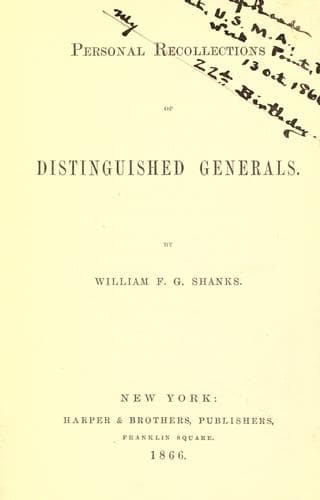
Personal Recollections of Distinguished GeneralsShanks, William Franklin Gore
History
Personal Recollections of Distinguished Generals
Shanks, William Franklin Gore
Generals -- United States; United States -- History -- Civil War, 1861-1865 -- Biography
peculiar legal talents of Rousseau, the attorney general employed him
to aid in the prosecution of Jeff Davis for treason, and to assist
Hon. John H. Clifford and William M. Evarts in the important duty of
endeavoring to define treason.
There occurred in Louisville in 1857 a trial of a very remarkable
character, which illustrates in a very interesting manner Rousseau's
legal ability and his decision and daring. A family of five or six
persons, named Joyce, were murdered, and their bodies burned in their
house near the city. Suspicion fell upon some negroes on the adjoining
plantation, and they were seized by the neighbors and threatened with
hanging if they did not confess. One or two of them were hung up for
a few moments and then let down nearly exhausted, but still persisted
in declaring their innocence. Another, however, tied to a stake, and
the fagots fired around him, agreed to confess, and, to avoid death
by burning, confessed that himself and the others arrested with him
had committed the murder. The negroes--four of them, all belonging to
one man--were thrown into jail to await their trial. Their master was
satisfied that they were innocent, and determined to engage the best
available counsel for them. This was easier to propose than to do, for
so great was the excitement among the people that, extending to the
lawyers, no other counsel besides Rousseau could be retained, and he
was compelled to undertake the defense unaided. He had always been very
popular in the district in which the murder had been committed, and
many of his old friends from the neighborhood visited him, and urged
him not to sacrifice his popularity with them by defending such abased
and brutal criminals as these negroes. In vain Rousseau urged that the
greater the guilt the greater the necessity for a lawyer. His friends
could listen to no reason, and saw no justification in defending
negroes who deserved to be hung according to their own confession. When
Rousseau intimated that he did not believe the confession, and alluded
to the manner in which it had been extorted, they would go away in
disgust, and many cursed him for "a damned abolitionist."
Public-domain text, read in full here on John Shaqi.
Reviews
Reviews
No reviews yet
Be the first to share your thoughts on this work.
Elsewhere in the archive
Join the Discussion
Join the discussion
Sign in to leave a comment or review.
Sign InorCreate an account