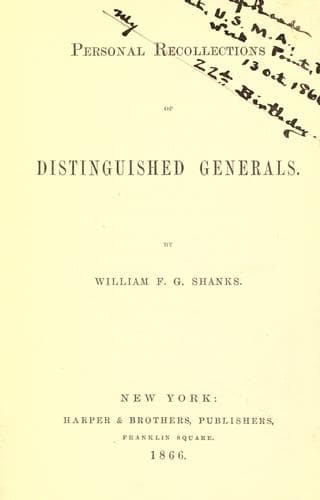
Personal Recollections of Distinguished GeneralsShanks, William Franklin Gore
History
Personal Recollections of Distinguished Generals
Shanks, William Franklin Gore
Generals -- United States; United States -- History -- Civil War, 1861-1865 -- Biography
He was answered by a wild shout and by the click of hundreds of
pistols. As he had spoken, young Joyce drew a huge knife from a sheath
fastened to his body, and, encouraged by the answering cry of his
friends, sprang toward the negroes. As he did so, however, Rousseau,
who stood between him and the prisoners, caught him by the throat with
one hand, and with the other clasped the wrist of the arm which held
the uplifted knife. It was but the work of a moment for a powerful man
like Rousseau to thrust Joyce back again in his seat and pinion him
there while he turned and confronted the crowd, who had made a rush for
the negroes, but who were being beaten back by the sheriff and one or
two policemen. As soon as they saw the position of young Joyce, still
held in his chair by the powerful arm of Rousseau, the crowd made a
rush in that direction. Rousseau was again prompt and decisive.
"Mr. Joyce," he said, "tell your friends that while they hang the
negroes I'll attend to you."
Joyce waved his friends back with the only hand left free, and quiet
again succeeded. It is hardly probable that even this promptness would
have saved Rousseau had he not been personally popular with the crowd.
As the crowd shrank back he released Joyce and turned abruptly to the
judge, who had ordered the sheriff to summon a force of the police to
protect the prisoners, and said,
"Don't do any thing of the sort. Don't do any thing of the sort, your
honor. We can protect the prisoners and ourselves. There are enough
true men here to protect them from the fury of this young man."
"Where are your friends?" cried the still furious crowd.
"You are!" exclaimed Rousseau, turning abruptly to them--I might say on
them. And then, without a single second's hesitation, he began a brief
speech, in which he passionately urged and entreated them to aid him
in preventing Joyce, whom he characterized as "this unfortunate young
man," from committing a deed which would forever be a curse to him as
long as he had a memory of it, and which would forever disgrace them
as a law-abiding community. While he was yet speaking the crowd calmed
down, and when he had finished painting the enormity of the offense
and the remorse of the young man if he had been permitted to commit so
great a crime, they cheered him, and through the room went frequent
and repeated whispers, "He's right;" "he's right;" "Rousseau's always
right!"
Public-domain text, read in full here on John Shaqi.
Reviews
Reviews
No reviews yet
Be the first to share your thoughts on this work.
Elsewhere in the archive
Join the Discussion
Join the discussion
Sign in to leave a comment or review.
Sign InorCreate an account