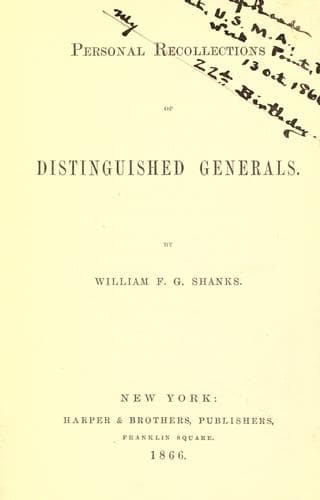
Personal Recollections of Distinguished GeneralsShanks, William Franklin Gore
History
Personal Recollections of Distinguished Generals
Shanks, William Franklin Gore
Generals -- United States; United States -- History -- Civil War, 1861-1865 -- Biography
The trial thenceforth proceeded in quiet until the announcement of
the verdict of "not guilty," when another terrible scene ensued; but
provision having been made for such an occurrence, the negroes were
carried off to jail for protection. The people were satisfied that the
negroes were guilty, and the verdict (obtained by Rousseau by showing
the inconsistencies of the confession and the circumstances, the
threats and the terror, under which it was extorted) only increased
their passion. The jail was surrounded, and the night after the
acquittal the negroes were taken out by the mob and hung on the trees
in the City Hall grounds. During the riot the mayor of the city, Mr.
Pilcher, while endeavoring to quiet the crowd, was struck by a missile
in the head, and died soon after from the effects of the injury
received.
This and several other trials eventually resulted in increasing
Rousseau's popularity. Two or three of his most important cases
embraced the defense of men accused and undoubtedly guilty of aiding
negroes to escape from slavery. It is hardly comprehensible that less
than a decade ago this offense was considered the most criminal act a
man could commit in Kentucky, or that men were sentenced to fifteen
years' hard labor for such offenses, or that convicts are still working
out their term for these offenses in Southern penitentiaries. To engage
in the defense of such criminals a few years ago, even in the latitude
of Louisville, was to be set down as an "abolitionist," and but few of
the Kentucky lawyers of the decade just before the war cared to bear
such a character. Rousseau, without courting the reputation, did not
fear it; and his manly bearing in all such cases, and in the political
excitement of the time, so advanced him in popular estimation that in
1860 he was elected to the State Senate of Kentucky without opposition
and as the candidate of both parties, whose only rivalry with regard
to him was as to which should first secure his acceptance of the
nomination. It was while holding this position as state senator that
Rousseau began his bold opposition to Kentucky neutrality, which
brought him so prominently before the country, and opened to him that
career in which he has won so much honor and such a high rank.
Public-domain text, read in full here on John Shaqi.
Reviews
Reviews
No reviews yet
Be the first to share your thoughts on this work.
Elsewhere in the archive
Join the Discussion
Join the discussion
Sign in to leave a comment or review.
Sign InorCreate an account