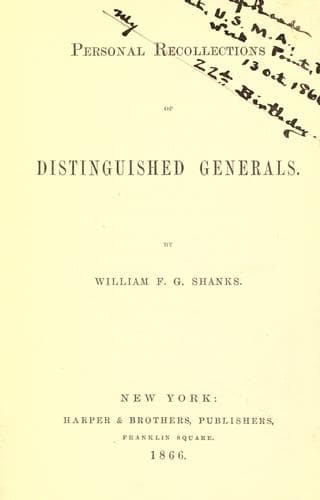
Personal Recollections of Distinguished GeneralsShanks, William Franklin Gore
History
Personal Recollections of Distinguished Generals
Shanks, William Franklin Gore
Generals -- United States; United States -- History -- Civil War, 1861-1865 -- Biography
The true story of Kentucky neutrality is one of the most romantic
episodes of the war. The visionary schemers who planned the Southern
Confederacy were guilty of dozens of chimerical and fallacious schemes,
whose shallowness is now so apparent that one wonders how the Southern
people were ever deceived by them. The rebel leaders declared--and
declared it so often that they actually believed it themselves--that
the Northern people would not fight. They boasted, and boasted so
frequently that they began after a time to believe, that one Southern
man could really whip five Yankees. They deceived themselves for so
many years with the doctrine of States Rights that leaders and people
began to believe that a fraction of the body corporate could exist
without the aid of the rest, and offered to this modern and enlightened
age a national illustration of Æsop's fable of the stomach's folly.
When the schemes of the rebel leaders were culminating, and they found
that the people of the Border States were not disposed, like those of
the Cotton States, to be hurried, regardless of consequences, into a
war in which they had nothing to gain and every thing to lose, they
instituted, with a shrewdness worthy the fame of a Philadelphia
lawyer, the no less visionary schemes that there could be law without
power, and that a portion of the body, and that portion the heart,
could suspend its operations while the rest was being violently
agitated. In Tennessee, where the first-named scheme was successful,
the rebels deceived the Union men into advocating the doctrine of "no
coercion." In Kentucky, where their complete success in carrying out
the second design was frustrated only by the sagacity of Rousseau,
the rebels deceived the Unionists into advocating the doctrine of
"neutrality." Twice the people of Tennessee voted against co-operation
with the rebel states; and when the rebels again dared to test the
question at the polls, they embodied in the contest the principle
that "the general government could not coerce a sovereign state," and
into the support of this doctrine the anti-secessionists foolishly
acquiesced. The first act of the President in calling for troops to
enforce the laws was construed into coercion, and the state seceded.
Three times the State of Kentucky voted by large majorities against
secession, but the rebels did not despair, and, having failed to get
the people to secede, or to declare against the right of coercion, they
endeavored, with but partial success, to commit the authorities and the
Unionists to what was called "a strict neutrality."
Public-domain text, read in full here on John Shaqi.
Reviews
Reviews
No reviews yet
Be the first to share your thoughts on this work.
Elsewhere in the archive
Join the Discussion
Join the discussion
Sign in to leave a comment or review.
Sign InorCreate an account