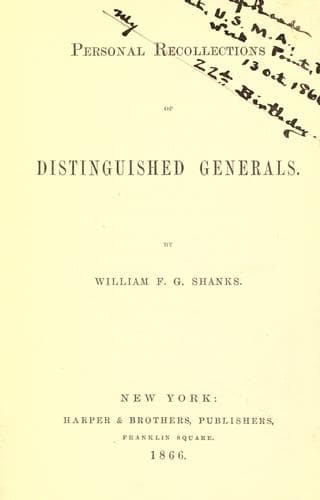
Personal Recollections of Distinguished GeneralsShanks, William Franklin Gore
History
Personal Recollections of Distinguished Generals
Shanks, William Franklin Gore
Generals -- United States; United States -- History -- Civil War, 1861-1865 -- Biography
This organization, under Buckner, existed when neutrality was
instituted, and the new doctrines gave it and the traitors who led it
additional strength, while it served to cloak their designs. Great
numbers of the leading Unionists of the state joined with the rebel
leaders in support of this doctrine, ridiculous and inconsistent as it
now appears to have been. A large majority of the people who had voted
against secession also became committed to the visionary doctrine,
until it came to be the accepted policy of the state; so that, when
Lovell Rousseau, in the Senate, in May, 1861, denounced neutrality as a
mask of the secessionists on the one hand, and a disgraceful yielding
of the Unionists on the other, he found few who agreed with him, and
less who seconded him in his avowed purpose of abolishing neutrality,
and placing the state, at all times, in her proper position as a true
member of the Union, amid the disasters of war as well as in the
prosperity of peace.
The public were not prepared to follow him, and he was forced to
accept neutrality as a compromise between union and secession, between
right and wrong, but doing so under public protest in the Senate
of the state, and declaring on every occasion which offered that it
was a debasing position, which he intended to abandon as soon as he
could induce the state to follow him. He found little support in this
honorable war upon neutrality until the secessionists, under Buckner,
went a step farther, and proposed, after hostilities had fairly begun,
to make the neutrality of Kentucky an "armed neutrality," urging that
the state troops be armed to resist encroachments from either rebel
or Union troops. In this proposition Rousseau saw an opportunity for
forcing a direct issue with the rebels, and he was quick to take
advantage of it. He saw in it actual aid to the rebellion. Against
this scheme, which proposed the appropriation of three millions of
dollars to arm the "Kentucky State Guard," he at once began a crusade
as earnest as it was untiring. He denounced the State Guard and its
leaders as secessionists and traitors, stormed at them in Senate-halls
and on the stump, and not only defeated the bill, but succeeded very
happily in dividing the State Guard into two rival organizations,
known as the "Home Guards" (Unionists) and "State Guardsmen" (rebels).
He called it at the time "separating the sheep from the goats." It
was a most fortunate achievement; for it not only saved thousands of
young men belonging to the State Guard from being unwittingly drawn
into the rebel army, but precipitated the designs of the rebels, and
hastened the defection which was inevitable. This was accomplished
under personal difficulties, opposition, and dangers, which only made
the labor more delightful to a person of Rousseau's temperament. He
delights in opposition; is in his element only when in the minority,
and strongly opposed; and his belligerent disposition led him to gladly
Public-domain text, read in full here on John Shaqi.
Reviews
Reviews
No reviews yet
Be the first to share your thoughts on this work.
Elsewhere in the archive
Join the Discussion
Join the discussion
Sign in to leave a comment or review.
Sign InorCreate an account