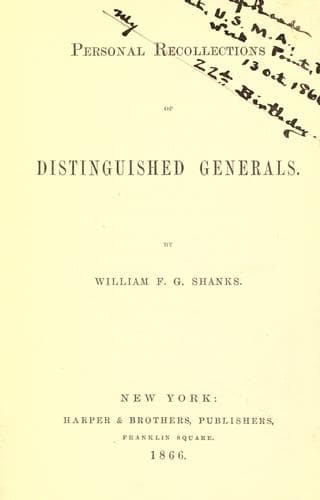
Personal Recollections of Distinguished GeneralsShanks, William Franklin Gore
History
Personal Recollections of Distinguished Generals
Shanks, William Franklin Gore
Generals -- United States; United States -- History -- Civil War, 1861-1865 -- Biography
accept not only the numerous stump and street discussions and disputes,
but even street quarrels and fights with the secessionists. The rebel
sympathizers seldom dared attack him openly, his bold front, at all
times maintained, making them prefer to exercise their strategy and
trickery against him rather than come to open warfare. Upon him, as the
head and front of the offending party, they poured all their abuse and
vituperation, but dared to do little more.
This split in the State Guard soon proved a serious affair, and the
"defection," as the traitors called the retirement of the Union men,
became quite general. Every incident increased the feeling; every
day saw the differences of opinions and the breach grow wider. On
one occasion Buckner was reviewing the regiment of the Guard which
was stationed at Lexington, Ky. The feeling between the partisans
composing the regiment had become quite demonstrative, and on this
occasion Captain Saunders D. Bruce, a Union officer of the regiment
(subsequently colonel of the Twentieth Kentucky Infantry, now a
resident of New York, and editor of the "Field, Turf, and Farm"
newspaper), made his appearance in the line with two small United
States flags as guidons for his company. Buckner, noticing them,
approached Captain Bruce, ordered him to the front, in full view
of the regiment, explained to him that Kentucky was neutral in the
"unfortunate struggle" then going on, and directed him to replace the
guidons by flags of the state. Bruce, without replying, turned to
his company, and, as if about to obey, gave the orders, "Attention,
company;" "Shoulder arms;" "Right face;" "Forward march," and away went
the "Lexington Chasseurs" out of the line, and for that matter out of
the State Guard. No attempt was made to stop the company, or to call
Bruce to account for his "insubordination."
No sooner had the work of dividing the State Guard been thus
accomplished, than Rousseau hastened to Washington to obtain permission
from the President to raise troops in the state for the United
States service. While on the way to Washington, he had an interview
with General McClellan, then commanding the Western Department, at
Cincinnati, and found him opposed to his scheme. McClellan sent to
Washington his aid, Colonel Key (subsequently dismissed the service
for disloyal utterances), to represent Rousseau's scheme as rash and
ill-advised. At the same time, others were sent to Washington by the
"mild-mannered" Unionists to urge the President not to grant Rousseau
permission to raise troops, arguing that it would at once precipitate
the invasion of the state by the rebels. Rousseau consequently found
great difficulty in obtaining the required authority, but went at the
question boldly.
Public-domain text, read in full here on John Shaqi.
Reviews
Reviews
No reviews yet
Be the first to share your thoughts on this work.
Elsewhere in the archive
Join the Discussion
Join the discussion
Sign in to leave a comment or review.
Sign InorCreate an account