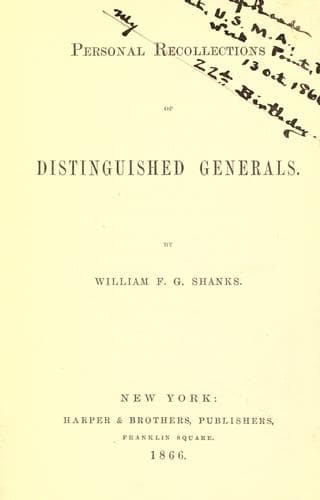
Personal Recollections of Distinguished GeneralsShanks, William Franklin Gore
History
Personal Recollections of Distinguished Generals
Shanks, William Franklin Gore
Generals -- United States; United States -- History -- Civil War, 1861-1865 -- Biography
In this way Rousseau represented to the President what he had done
in the way of defeating the schemes of the rebels to arm themselves
at the expense of Kentucky, and in dividing the state militia into
two classes. He had inspired the loyal Home Guards with an _esprit de
corps_, which would save the greater part of them from any connection
with the secessionists; but he represented also that there were
thousands of young men in the state who had not decided to follow
either the rebel or loyal banner, and that, knowing this, the rebels
were recruiting in every part of the state. Thousands of the young and
thoughtless would be, and hundreds were being, drawn into the rebel
army by this means, and he argued that the government ought to recruit
in this neutral state as an encouragement to the young men to join the
loyal army.
But the President took time to consider, and Rousseau withdrew. The
next day Mr. Chase drew up in regular form the authority Rousseau
desired, and Cameron signed it and gave him a commission as colonel,
the rank dating from June 15th, 1861. Both Chase and Cameron promised
to endeavor to obtain the President's sanction of the act, that
Rousseau might feel perfectly free to go to work. Rousseau was granted
another interview with the President, who, after some farther
conversation on the subject, indorsed Rousseau's original application
to be permitted to raise troops as follows:
"When Judge Pirtle, James Guthrie, George D. Prentice, Harney, the
Speeds, and the Ballards shall think it proper to raise troops for the
United States service in Kentucky, Lovell H. Rousseau is authorized to
do so."
This he handed to Rousseau and asked, "Will that do?"
Rousseau read it carefully, and then replied, somewhat disappointed,
"No, Mr. President, that won't do."
"Why not, why not, Rousseau? These men are good Union men."
"Yes, sir, good men and loyal, Mr. Lincoln, but nearly all of them
differ with me on this subject, are committed to the abominable
doctrine of neutrality, and it would be too late when the majority of
them conclude that it would be proper to raise troops. Then I fear the
state will have seceded. I had hoped, sir, that what the War Department
has done in my case would be acceptable to you."
"What has Cameron done?" asked the President.
"He has, by the advice of Mr. Chase, authorized me to raise two
regiments in Kentucky."
"Oh!" said Mr. Lincoln, after reading the documents, "if the War
Department has acted in the matter, I have nothing to say in
opposition."
Rousseau, fearful that too much might be said, at once arose, shook the
President's hand, and vanished.
Public-domain text, read in full here on John Shaqi.
Reviews
Reviews
No reviews yet
Be the first to share your thoughts on this work.
Elsewhere in the archive
Join the Discussion
Join the discussion
Sign in to leave a comment or review.
Sign InorCreate an account