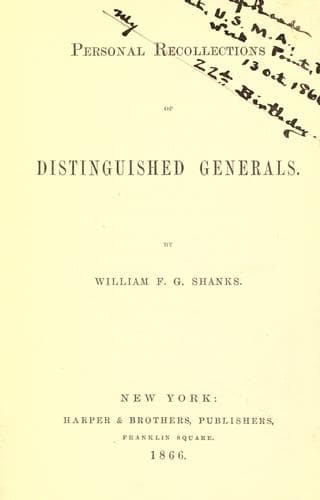
Personal Recollections of Distinguished GeneralsShanks, William Franklin Gore
History
Personal Recollections of Distinguished Generals
Shanks, William Franklin Gore
Generals -- United States; United States -- History -- Civil War, 1861-1865 -- Biography
On his return to Kentucky, Rousseau, in deference to the President's
wishes, as implied in the indorsement of his paper, consulted James
Speed, and through him called a meeting of the gentlemen named, and
also of others in the city of Louisville and interior counties of the
state. Much to the surprise of Mr. Speed, only himself, his brother
Joshua, Bland and John P. Ballard, Samuel Lusk, Morgan Vance, and John
H. Ward, a minority of the meeting, hardly respectable in numbers, were
in favor of the project. Pirtle, Guthrie, Prentice, Harney, Bramlette,
Boyle, and others, opposed it strongly, and in the end adopted
resolutions to the effect that the time had not come; that it was then
impolitic, unwise, and improper to enlist troops for the United States
service in Kentucky; but adding that when the time did arrive, they all
wished Rousseau, in whom they expressed every confidence, to head the
movement. Rousseau had made up his mind that such would be the result
of their deliberations (from which he had retired before the final
action), and had decided upon his course; so that when Joshua Speed
next day handed him the resolutions, Rousseau was neither surprised nor
chagrined, but very much disgusted. A few minutes after leaving Mr.
Speed on this occasion, he met Bramlette, subsequently governor of the
state, and that gentleman began to defend the majority of the meeting
of the night before for their action in the matter, when Rousseau
interrupted him by asking if any thing had been said in opposition to
the enlistment of troops by him in other states. Bramlette replied in
the negative, when the two parted, and Rousseau immediately began the
enlistment of Kentuckians, but established his camp and swore in his
recruits in Indiana. Being compelled to do this was very humiliating
to Rousseau, but it did not dishearten him, and he went at his work
energetically. There were greater obstacles in his way at that time
than the mere opposition of men as to time and place. When he began
the work of enlistment, the government had no credit in Kentucky, and
the expenses of enlisting and feeding his two thousand recruits were
defrayed by himself and a gentleman living in Indiana named Samuel
Patterson, whose name, for the sake of his devoted loyalty, deserves
to go down to history. Despite these obstacles, despite the fact that
every paper in the state ridiculed the project and laughed at the
projector, nevertheless Rousseau's recruits--the rebels called them
"Rousseau's ragamuffins"--increased in numbers and grew in discipline
until they became formidable, and eventually saved the city from rebel
occupation.
Public-domain text, read in full here on John Shaqi.
Reviews
Reviews
No reviews yet
Be the first to share your thoughts on this work.
Elsewhere in the archive
Join the Discussion
Join the discussion
Sign in to leave a comment or review.
Sign InorCreate an account