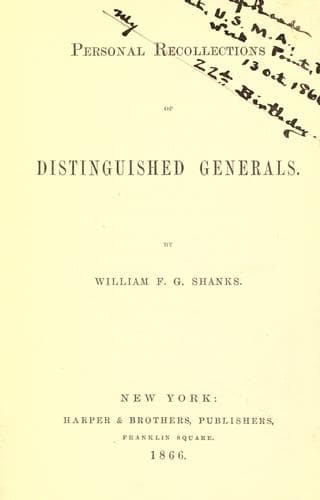
Personal Recollections of Distinguished GeneralsShanks, William Franklin Gore
History
Personal Recollections of Distinguished Generals
Shanks, William Franklin Gore
Generals -- United States; United States -- History -- Civil War, 1861-1865 -- Biography
roof of the Courier newspaper office, and to aid him in this the rebels
gathered around him. But it was destined that this feat should not be
accomplished. One of the policemen of the city, named Green, having
received orders to suppress all noisy demonstrations such as Tompkins
was guilty of in hallooing for Davis and the Confederacy, approached
him and ordered him to desist. The only reply was a repetition of the
offense. Green again repeated his order, explaining that these were
his instructions, when Tompkins drew a pistol, and, retreating a few
steps, fired at the policeman. Simultaneously Green had also retreated
a few steps, drawing his pistol at the same time, and, in answer to the
other's ineffective fire, shot the rioter directly through the heart,
killing him instantly. Never was a riot so cheaply suppressed nor so
instantaneously. In ten minutes after the death of the ringleader the
rioters dispersed, rebel flags disappeared, the huzzas for Davis were
hushed: not a rebel remained on the streets, not a flag was to be seen
unfurled, not a huzza was to be heard, and Louisville slept sounder
that night than she had slept for months.
The secessionists of Louisville did not, however, entirely desist from
their efforts to aid the rebels, but on the 17th of August they called
a meeting of sympathy with the South. At night, in pursuance of the
call, they early mustered their strength at the court-house. Their
leaders were on the stand, which was handsomely decorated with white or
"peace" flags, awaiting the filling of the hall by their friends, and
somewhat anxious at the appearance of numerous well-known Unionists, or
"abolitionists," as they were then called by the rebel sympathizers.
Every thing was in readiness to open the peace meeting, and James
Trabue, the principal secession leader, had risen to call the assembly
to order, when James S. Speed, late United States Attorney General,
quietly walked upon the stand and approached the desk prepared for the
chairman. He called the attention of the house by rapping on the desk
with his cane, knocked aside with an air of contempt the "peace" flags
on either side of him, and was about to speak, when he was interrupted
by the clamor of the rebel leaders, who insisted that the house was
theirs, and that the meeting was to be addressed by them. Amid the
excitement, and above the clamor which ensued, was heard the stentorian
voice of Rousseau, proposing Judge Speed as president of the meeting.
He immediately put the question to a vote. A deafening "Ay!" drowned
the "Noes" of the rebels, and, perfectly calm and cool, Mr. Speed
reached forward, removed the white flags from the stand, and unfurled
two small star-spangled banners in their stead. In an instant, as if by
preconcerted arrangement, from different parts of the hall, large and
small United States flags were unfurled, and ten minutes afterward the
secessionists had left the hall, amid the groans of the loyal citizens.
Public-domain text, read in full here on John Shaqi.
Reviews
Reviews
No reviews yet
Be the first to share your thoughts on this work.
Elsewhere in the archive
Join the Discussion
Join the discussion
Sign in to leave a comment or review.
Sign InorCreate an account