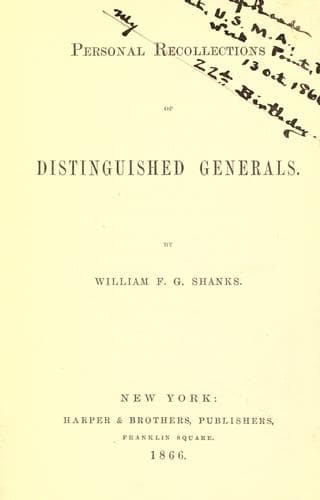
Personal Recollections of Distinguished GeneralsShanks, William Franklin Gore
History
Personal Recollections of Distinguished Generals
Shanks, William Franklin Gore
Generals -- United States; United States -- History -- Civil War, 1861-1865 -- Biography
brother requested the congregation to join him in prayer, and prayed
for "the rulers set over us, and the removal from his place of power
of Kentucky's traitorous governor." This was a positive defiance; the
rebelliously-inclined brother felt it his duty to reply, and did so
in a regular secession prayer, asking the blessing of heaven on "the
Confederate government, rulers, and people," and "confusion upon the
councils of the Northern abolitionists and vandals." To close the bout
and end the affray of words, the Unionist replied in a regular true
blue Union prayer, asking that God would bless and prosper the Union
cause, smile upon her arms, lead her soldiers to triumph, smite the
traitors, and bring back to their allegiance our misguided brethren of
the South; and capped the climax which he had reached by giving out the
hymn beginning
"Oh, conquer this rebellious will."
The secessionist did not reply, and thus the Unionist won his first
victory. He was a graduate of West Point, but I do not know that what
he learned there aided him much in his praying match.
The excitement of this conflict of ideas and passions reached its
culminating point at Louisville on the day following the battle of
Bull Run, and produced one of the most remarkable scenes I have ever
witnessed. The first telegraphic news of the battle, published on the
morning after the engagement, was of a highly favorable character,
and the Unionists of Louisville ate their breakfasts and digested the
good news of the first great victory with the firm conviction that
Mr. Seward was right, and that the war would be over in ninety days,
if not sooner. That morning every thing was _couleur de rose_ to even
less sanguine natures than Mr. Seward. About noon of the same day
the bad news began to arrive, but the people knew nothing definite
regarding the final result of the battle until about three o'clock
P.M., when the afternoon editions of the papers made their appearance.
Then the news of the rebel victory spread like wildfire, and in half
an hour--at the time, it seemed as if it were instantaneous--the
whole city was a perfect pandemonium. The rebel flag, which had until
then shrunk from the light, flaunted from buildings and dwellings,
from carriage windows in the hands of women, on omnibuses, and carts,
and trucks, and wagons in the hands of men wild with excitement.
Men on horseback, with the rebel flag flying, dashed wildly through
the principal streets, crying with husky voices, "Hurrah for Jeff.
Davis." The streets were alive with drunken and noisy rebels, who
hooted at Unionists, cheered secessionists, embraced each other, and
yelled themselves hoarse in bravos for "Jafe Davis." For nearly two
hours the rebels had full possession of the city, and crowded about
their ringleader, a notorious fellow named John Tompkins, with every
expression of their delight. It was decided, and Tompkins announced his
intention, to raise a flag-staff and display the rebel flag from the
Public-domain text, read in full here on John Shaqi.
Reviews
Reviews
No reviews yet
Be the first to share your thoughts on this work.
Elsewhere in the archive
Join the Discussion
Join the discussion
Sign in to leave a comment or review.
Sign InorCreate an account