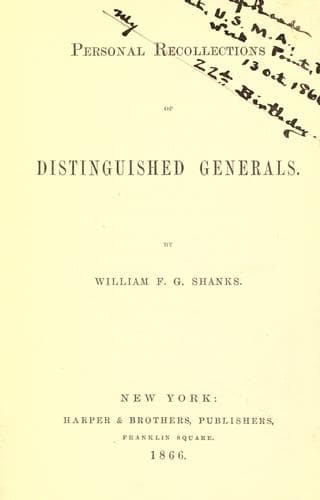
Personal Recollections of Distinguished GeneralsShanks, William Franklin Gore
History
Personal Recollections of Distinguished Generals
Shanks, William Franklin Gore
Generals -- United States; United States -- History -- Civil War, 1861-1865 -- Biography
Rousseau was much predisposed, by reason of his mental organization, to
excitability under fire, but it did not detract from his administrative
power. He was as clearly administrative in danger as the more
phlegmatic Thomas or Grant, but in a different way. Rousseau made
very little, if any, use of his aids. If he had an order to give, he
galloped across the field and gave it himself. If he had an advance
to order, it was done by leading the troops in person. During this
battle of Perryville, General McCook sent me to inform Rousseau, who
was on the extreme left of the line, that his right was being turned
and was falling back. Rousseau galloped to the endangered part of the
line and rallied the troops in retreat, beating and cursing them into
line, and actually breaking his sword over the head of one demoralized
individual, who was thus brought to a stand. The enemy, however,
continued to advance, and Rousseau was compelled to look around for
farther assistance. Seeing Captain Charles O. Loomis's battery in
position, in reserve, commanding a little valley into which the enemy
had deployed, and through which they were rapidly advancing, he rode up
to Captain Loomis and ordered him to open with canister. Loomis had not
perceived the advancing enemy, and explained to Rousseau that he had
been ordered into reserve by General McCook, and told to reserve his
fire for close work.
"Close work!" exclaimed Rousseau; "what the devil do you call that,
Captain Loomis?"
He pointed down the valley, and Loomis saw in an instant the
advancing foe and his own danger. Loomis was a minute-man--one of the
quickest-witted and brightest-eyed men I ever met--and in a second
his six guns were pouring a destructive cross-fire into the rebel
ranks that at once played havoc with the enemy and encouraged our own
forces. The enemy thus advancing had flanked Lytle's brigade, and it
was now falling back toward Loomis's position, but Rousseau's personal
direction and appearance (Lytle had been left for dead on the field),
and the opening guns of Loomis, soon reassured the men in retreat, and
the line re-formed. About the same time Sheridan's brigade was ordered
in on the left by General Buell, and the enemy were speedily and
bloodily repulsed.
Public-domain text, read in full here on John Shaqi.
Reviews
Reviews
No reviews yet
Be the first to share your thoughts on this work.
Elsewhere in the archive
Join the Discussion
Join the discussion
Sign in to leave a comment or review.
Sign InorCreate an account