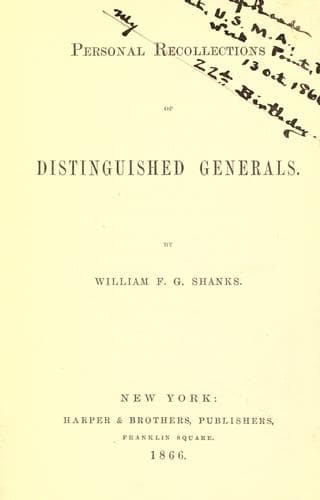
Personal Recollections of Distinguished GeneralsShanks, William Franklin Gore
History
Personal Recollections of Distinguished Generals
Shanks, William Franklin Gore
Generals -- United States; United States -- History -- Civil War, 1861-1865 -- Biography
His conduct in this engagement gained Rousseau his promotion to a major
generalcy. The commission read, "promoted for distinguished gallantry,"
and was the first of the numerous promotions for gallantry issued
during the war for the Union. His great popularity with the troops may
be said to have dated from this day; and it grew still greater after
the battle of Stone River, where, though commanding the reserves, he
was among the first engaged. The love of the men became so intense
that it broke out on every occasion. On the march, in camp, on parade,
their admiration grew demonstrative, and cheers greeted him wherever he
went. During the winter of 1862-'63, while the troops were in camp at
Murfreesborough, great numbers of rabbits were frequently frightened
from their burrows, when an entire regiment would start in pursuit with
noisy yells. The demonstrations of admiration for Rousseau and these
noisy pursuits of the rabbits became so frequent that it was a common
remark, whenever the cheering of the soldiers was heard, that they were
either after "Rousseau or a rabbit."
I have said that Rousseau was clearly administrative under all
circumstances. He was once, and once only, known to betray any
considerable nervousness under fire. It was during a brief engagement
fought at Chehaw Station, when on his famous Alabama raid. He had sent
forward Colonel Thomas Harrison, of the Eighth Indiana Cavalry (better
known as the Thirty-ninth Mounted Infantry), to destroy a part of the
railroad in his rear--the expedition then being on its return, having
performed its principal purpose. Colonel Harrison unexpectedly became
briskly engaged with the rebel forces under General James H. Clanton.
Rousseau was some distance in the rear of the fight, and the extent of
the engagement was only known to him by the amount of the firing and
the number of wounded men brought to the rear. One of his aids--Captain
Elkin--observed Rousseau's nervousness gradually increasing, as evinced
by his twirling his long black mustache, and repeating aloud, but
evidently communing with himself,
"I shouldn't have got into this affair. I'm very much afraid this isn't
judicious."
Elkin penetrated through the swamps to Harrison's front, and returned
with the information that the enemy were being driven, and that the
result was not at all doubtful.
"There's no reason," he said, "to be uneasy about Harrison, general."
"Uneasy about Harrison!" exclaimed the general. "Tom Harrison can whip
all the militia in Alabama. But what shall I do with my poor wounded
boys? We are a thousand miles from home, and no way to carry them
comfortably?"
He had to leave his wounded, and he took rather odd but effective means
to have them well cared for. Having succeeded in capturing a company
of Montgomery Cadets, the members of which were all young boys of less
than seventeen years of age, he had them drawn up near his quarters,
and released them unconditionally, with this suggestion:
Public-domain text, read in full here on John Shaqi.
Reviews
Reviews
No reviews yet
Be the first to share your thoughts on this work.
Elsewhere in the archive
Join the Discussion
Join the discussion
Sign in to leave a comment or review.
Sign InorCreate an account