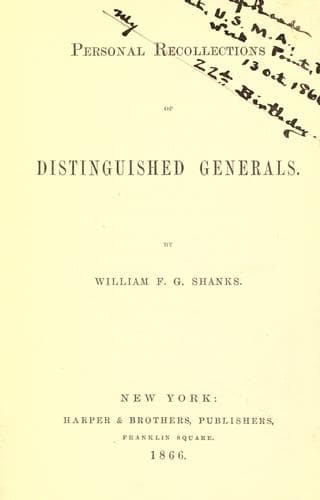
Personal Recollections of Distinguished GeneralsShanks, William Franklin Gore
History
Personal Recollections of Distinguished Generals
Shanks, William Franklin Gore
Generals -- United States; United States -- History -- Civil War, 1861-1865 -- Biography
I have not space here to enter as I could wish into the details of
Rousseau's military career. He must always remain a representative of
one of the peculiar phases of the late war, and every event I could
give will in the future be valuable; but at this time it is impossible
to allude farther to his military career. He left the army soon after
the battle of Nashville (during which engagement he held the left
position of Thomas's line at Fortress Rosecrans, near Murfreesborough),
and returned to Louisville at the request of his friends, to contest
with Robert Mallory, Esq., the latter's place in Congress. That
congressional race was nothing more nor less than a crusade against
the remnant of slavery left by the war in Kentucky, probably as a
punishment for her attempted crime of neutrality. It was another
brilliant triumph won by the exercise of the same decisive action which
has always characterized him. The Convention which nominated Rousseau
was, in political parlance, merely a "pocket convention," and its
nominee found, on leaving the military field to examine the political
course, that he had really no party to back him. He had to build up a
party, and without hesitation he decided that it should be an avowedly
abolition party in principle and purpose. He began by announcing that
he favored the adoption by the State of Kentucky of the constitutional
amendment abolishing slavery, and denounced slavery as unjust, unwise,
and impolitic--a curse and blight on the state. When he first made the
speech in which he declared this, the people wildly stared at him, and
when he had done they pronounced him insane. They were so completely
blinded by their prejudices that they could or would not see the truth
of his arguments, and at last he resorted to ridicule with better
effect.
"I wish to say again," he said, on one occasion, "that slavery, thank
God, is dead. Its own friends have destroyed it. They placed it at
the foundation of Jeff Davis's government, and invited, nay, forced
us to assail it. They forced the whole liberal world to make war upon
it, and presented to us the alternative to destroy slavery or see
our government perish. Our duty was a plain one, to kill slavery and
rebellion with it, and let the government live. Both of these things
are accomplished facts, and in the whole Christian world there remain
but three slave states--_Cuba, Brazil, and Kentucky_."
Public-domain text, read in full here on John Shaqi.
Reviews
Reviews
No reviews yet
Be the first to share your thoughts on this work.
Elsewhere in the archive
Join the Discussion
Join the discussion
Sign in to leave a comment or review.
Sign InorCreate an account