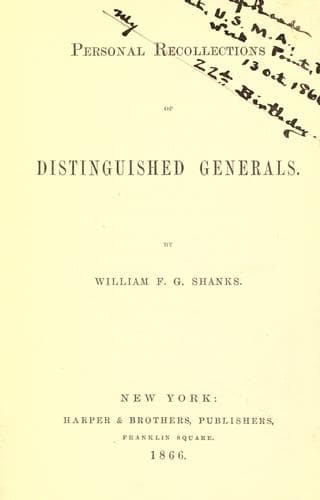
Personal Recollections of Distinguished GeneralsShanks, William Franklin Gore
History
Personal Recollections of Distinguished Generals
Shanks, William Franklin Gore
Generals -- United States; United States -- History -- Civil War, 1861-1865 -- Biography
This climax, so ridiculous to every Kentuckian with any state pride
in his soul, was hailed wherever heard with shouts of laughter; and
Rousseau once remarked that it was a curious fact that the laughter
generally began with the returned rebel soldiers, who possess less
pro-slavery prejudices than the rebels who stayed at home. Rousseau
generally followed up this effective ridicule with what he called
his "special argument against slavery." "We in Kentucky," he would
say, "are in the habit of arguing the slavery question more from the
economical than the moral stand-point;" and he would then go on to
show how the institution had curtailed the prosperity of Kentucky and
of the South. "But," he would add, "I wish to add a little argument of
my own. I want to tell you why slavery will not pay. It is because we
have a God in heaven, who has arranged the affairs of men in such a way
that wrong and injustice won't pay, and don't pay. Has not the South
lost more in the destruction of houses, and fences, and railroads, and
crops, and other property, and expenditures for munitions of war, etc.,
in the last four years of a rebellion, carried on for the benefit of
slavery, than it wrung out of the sweat of the slave in the forty years
preceding? Add to this the half a million of her brave sons who died
or were crippled in battle and in camp, half the entire arms-bearing
population of the rebel states, and tell me if slavery was a paying
institution to them? And do you think it can be restored now and not
lead to a bloodier and fiercer war? And why is this? Simply because God
in his wisdom has arranged the world so that in the long-run a system
of wrong will not and can not pay."
After four weeks active canvassing of the district Rousseau was
returned to Congress by a heavy majority, although the opposition
pro-slavery party employed a former United States officer to make the
race in order to split the Union or amendment vote. The scheme failed.
Rousseau's personal popularity, and his positive, determined, and
patriotic stand, carried him successfully through, and he was shortly
after nominated for the Senate, which position he will doubtless
attain. In these crusades against neutrality and slavery Rousseau has
established a character for firmness and persistence which have made
him a most popular leader and the first man of his state; and he is
already accepted as the true successor in principles, purposes, and
patriotism of the late great leader in Kentucky, Henry Clay.
Public-domain text, read in full here on John Shaqi.
Reviews
Reviews
No reviews yet
Be the first to share your thoughts on this work.
Elsewhere in the archive
Join the Discussion
Join the discussion
Sign in to leave a comment or review.
Sign InorCreate an account