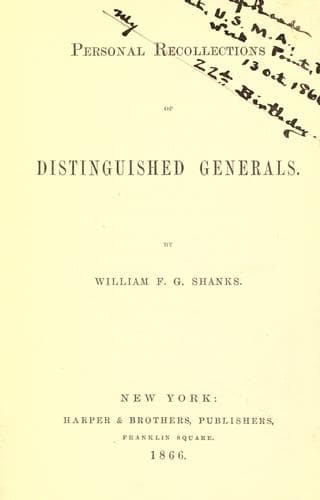
Personal Recollections of Distinguished GeneralsShanks, William Franklin Gore
History
Personal Recollections of Distinguished Generals
Shanks, William Franklin Gore
Generals -- United States; United States -- History -- Civil War, 1861-1865 -- Biography
The very close intimacy existing between Sherman and Rousseau is
a fine illustration of the rule that opposite natures are often
kindred spirits. Two natures in greater contrast can hardly be
conceived. Rousseau has none of Sherman's nervousness of thought or
action, while Sherman has nothing of the excitability of Rousseau
under fire. Rousseau is personally a most conspicuous--perhaps _the_
most conspicuous officer in the United States army, while Sherman
is among the most commonplace in appearance. Yet their friendship,
which began early in the war, is hardly the less remarkable than that
existing between Grant and Sherman, and is much more demonstrative,
because Rousseau and Sherman are of affectionate and demonstrative
dispositions, while Grant is rather cold and formal. Sherman was very
fond of quoting Rousseau's speech about him, delivered at the banquet
to the latter at Louisville in 1862. Rousseau had then said of Sherman:
"Of all the men I ever saw, he is the most untiring, vigilant, and
patient. No man that ever lived could surprise him. His enemies say
he was surprised at Shiloh. I tell you no. He was not surprised, nor
whipped, for he fights by the week. Devoid of ambition, incapable of
envy, he is brave, gallant, and just. At Shiloh his old legion met him
just as the battle was ended, and at the sight of him, placing their
hats upon their bayonets, gave him three cheers. It was a touching and
fitting compliment to the gallant chieftain. I am thankful for this
occasion to do justice to a brave, honest, and knightly gentleman."
When Sherman first read this speech, immediately after the battle, when
he was still laboring under the insanity charge, he jumped from his
seat, ran around his quarters from tent to tent, reading the speech to
all his staff, and swearing that there was "one sensible man in the
country who understood him."
As may be rightly suspected from this article, Rousseau is rather a
hero of mine. He has many of the most admirable qualities of man; and
in long years of intercourse with him I saw a great deal to admire,
and but little to condemn. I defy any man with an honest love of bold,
albeit rugged honesty, to know the man and not to admire him. He was
loyal, true, and affectionate to the back-bone. He stuck to his friends
to the last, and only the firmer in adversity. The strong pressure
of his mighty hand gave you no fear of what the clenched fist might
do, but inspired confidence. He was, perhaps, too unsuspicious, and
too hopeful and buoyant: these were the faults of his character, if
faults it had, for knaves frequently imposed on him in the guise of
honest poverty, and his hopeful nature sometimes led him to promise
his friends more than he had the power, but not more than he had the
disposition to perform.
Public-domain text, read in full here on John Shaqi.
Reviews
Reviews
No reviews yet
Be the first to share your thoughts on this work.
Elsewhere in the archive
Join the Discussion
Join the discussion
Sign in to leave a comment or review.
Sign InorCreate an account