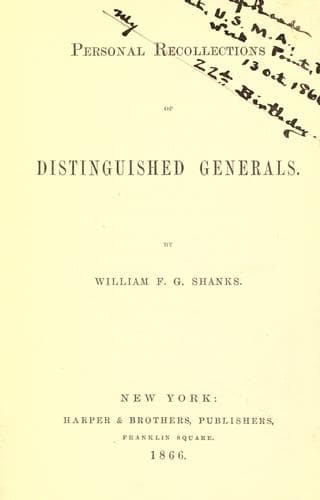
Personal Recollections of Distinguished GeneralsShanks, William Franklin Gore
History
Personal Recollections of Distinguished Generals
Shanks, William Franklin Gore
Generals -- United States; United States -- History -- Civil War, 1861-1865 -- Biography
Yet some few of them did not lack in ability, or the industry, energy,
and courage which creates opportunity and wins renown. One of those
whom circumstances robbed of his just renown, and who is now generally
looked upon as one of the greatest failures of the war, was to my
mind one of our ablest soldiers, and, as a tactician, was the equal
of Grant or Thomas, or any of their subordinates. General Don Carlos
Buell was a perfect soldier--perfect in manner, bearing, coolness,
courage, energy--physically and mentally a perfect soldier--but he
failed. If he had a fault, it resulted from education, and from this
fault came this failure. "A little learning is a dangerous thing,"
as Pope, Bulwer Lytton, and every other person who has attempted
to dispense knowledge second-handed has discovered to his sorrow;
but there is also such a thing as drinking too deep of the "Pierian
Spring." To be a valedictorian is quite often to be an unfortunate; and
more signal failures have emanated from the first section (Engineer)
graduates of West Point, and the valedictorians of Yale and Hartford,
than from less brilliant, less studious, but more practically educated
classes of the same institutions. Not one of the valedictorians of West
Point, from the time at which class-rank was first established--1820,
I believe--has ever made a great success in practical life, and few
of them have ever been famous outside of the army. They are learned
and able undoubtedly, but they lack in practicability, and, when
they come to wrestle with the world, find themselves ill adapted to
the struggle. The Engineer Corps of the army into which the higher
graduates of the Academy are placed has given us fewer successful
soldiers than the Infantry, which is considered the lowest arm of the
service. All of the engineers have, as generals, been visibly affected
in their administration, strategy, and tactics by their education, and
have preferred to depend more upon mud walls than living phalanges,
and their strategic marches have been more correct in mathematical
calculations than successful in execution. Benham, Stevens, Franklin,
W. H. C. Whiting, McPherson, McClellan, Lee, and dozens of others I
could name, have in the late war proven this to be true; and Quincy A.
Gilmore has proved about the only exception to the rule, doubtless from
the fact that after his graduation he left the Engineer Corps for the
Artillery.
Public-domain text, read in full here on John Shaqi.
Reviews
Reviews
No reviews yet
Be the first to share your thoughts on this work.
Elsewhere in the archive
Join the Discussion
Join the discussion
Sign in to leave a comment or review.
Sign InorCreate an account