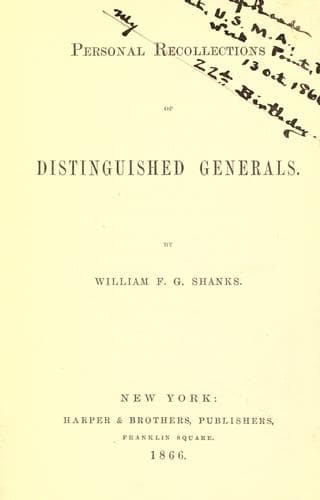
Personal Recollections of Distinguished GeneralsShanks, William Franklin Gore
History
Personal Recollections of Distinguished Generals
Shanks, William Franklin Gore
Generals -- United States; United States -- History -- Civil War, 1861-1865 -- Biography
Buell was not exactly a valedictorian, and was not in the Engineer
Corps, but nevertheless he was one to whom all this I have said
and exampled is applicable. He was not made impracticable, but too
methodical by his pupilage. Not too much learning, but too much routine
ruined him. He was not too much of a book-worm, but too much of a red
tapist. His Alma Mater was not West Point, but that more pitiless
school, the adjutant general's office. Thirteen years' constant service
in that department of the army made him too systematic--smothered the
fire in his heart, the impulsive in his nature, and, like Thomas,
he taught himself "not to feel." It rendered him cool in danger,
while not depriving him of his readiness in emergency, but it also
unfortunately made him so systematic that it injured the originality
of his conceptions. The adjutant general's office made him too much of
a regular, so that when he came to command a great volunteer force he
looked for and strove in vain to attain the perfectness in appointment,
organization, drill, and all that routine duty to which he had been
accustomed in the old army. Buell was a thoroughly educated soldier,
as a strategist and tactician the equal of Grant; but he was too much
of an organizer, and this, with a volunteer army to command, really
detracted from his merit. Good organizers of large armies seldom
succeed in handling them to signal advantage. Buell was too good an
organizer. This mere routine duty absorbed too much of his mind; his
mind became too much accustomed to dwell upon that specialty, and
he gave it too much importance and consideration. So thoroughly had
Buell's mind become imbued with the importance of giving to volunteer
armies the precise organization of the regulars, that in taking leave
of the army which he had formed from "Sherman's mob," he congratulated
the soldiers who had saved us Shiloh, first, as more important in his
eye than their victories, on their conversion "from raw levies into
a powerful army, honored by common consent for its discipline and
efficient organization, and for its _esprit de corps_."
Public-domain text, read in full here on John Shaqi.
Reviews
Reviews
No reviews yet
Be the first to share your thoughts on this work.
Elsewhere in the archive
Join the Discussion
Join the discussion
Sign in to leave a comment or review.
Sign InorCreate an account