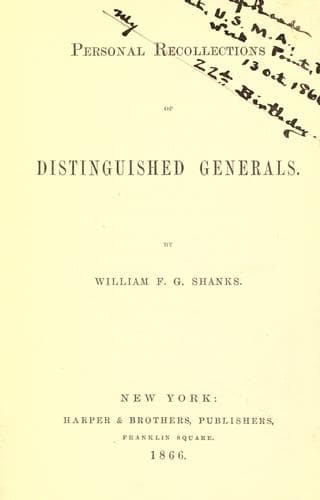
Personal Recollections of Distinguished GeneralsShanks, William Franklin Gore
History
Personal Recollections of Distinguished Generals
Shanks, William Franklin Gore
Generals -- United States; United States -- History -- Civil War, 1861-1865 -- Biography
And yet this army thus congratulated was the weakest in organization
of any great army that ever existed. It was not imperfect in its
details; on the contrary, it was very admirable in that respect, but
certainly no army was ever so weak in its corps commanders--McCook,
Crittenden, and Gilbert. Circumstances took the organization out of
Buell's hand. On the arrival of the army at Louisville in pursuit of
Bragg, in September, 1862, General Halleck, then commander-in-chief,
concluded that Buell ought to be removed. Halleck was one of those men
who, instead of arguing himself from an array of facts into a correct
position, would first conclude that affairs were in the condition that
he wished or feared, and would then argue himself into the belief that
they undoubtedly were so. He would wish his enemy to occupy a certain
position, and actually bring himself to the belief that he had done so.
Too good a lawyer ever to be a good soldier, he depended for success
on tricks in war as he had on quibbles in the law. He concluded, in
1862, that Buell's army was demoralized through want of confidence in
its commander, and decided upon his removal. The command was tendered
to General George H. Thomas, who not only declined, but promptly urged
the retention of General Buell. The other corps commanders then joined
in this request, and Buell was retained. He was forced to hastily
organize his army in order to continue the pursuit of Bragg, and,
consolidating Nelson's army, decided upon three corps, with Nelson,
McCook, and Crittenden in command, while General Thomas acted as
second under Buell. This last arrangement was very faulty. Thomas was
the best man in the army, and this arrangement virtually deprived the
army of his services, and made him merely an inspector general. Before
the campaign had opened, Nelson, who was a very superior soldier, was
assassinated, and his place was supplied--it is really ridiculous to
say so, however--by General C. C. Gilbert. Never did a single army
possess three such weak corps commanders as Alexander McDowell McCook,
C. C. Gilbert, and Thomas L. Crittenden. They were doubtless brave
and gallant--every soldier is supposed to be that; they doubtless did
their duty to their full ability--every soldier does that, and expects
no particular commendation for it; but these men were not capacitated
by nature or education for the positions they held. Not one of them
had any iron in his nature--neither were deep reasoners or positive
characters. They were of that class of men who "intended to do well,"
but who, without any fixed and unswerving principle to guide them,
vacillated and procrastinated until the great motive and the propitious
time for action had passed, and left them the doers only of positive
evil or negative good, which is just as bad. McCook was an overgrown
school-boy, without dignity (Sherman, once alluding to him, called him
"a juvenile"); Crittenden was a country lawyer with little legal and no
Public-domain text, read in full here on John Shaqi.
Reviews
Reviews
No reviews yet
Be the first to share your thoughts on this work.
Elsewhere in the archive
Join the Discussion
Join the discussion
Sign in to leave a comment or review.
Sign InorCreate an account