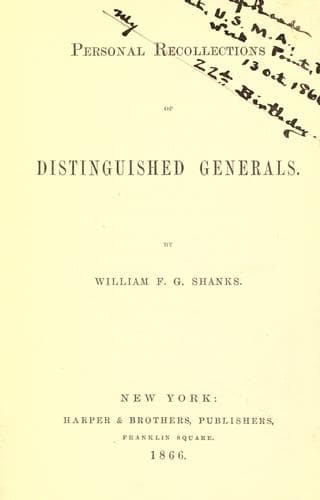
Personal Recollections of Distinguished GeneralsShanks, William Franklin Gore
History
Personal Recollections of Distinguished Generals
Shanks, William Franklin Gore
Generals -- United States; United States -- History -- Civil War, 1861-1865 -- Biography
"Governor, according to all the rules of military art, I ought to
evacuate this city, for its possession depends upon the result of the
battle which is to be fought with Bragg in Kentucky, whither he is now
advancing, and where I am pursuing him. To hold this city deprives me
not only of a large force available in a battle, but also places me at
the disadvantage of having to watch two important points, Louisville
and Nashville, at once. If Bragg is attacked and defeated (and the
force necessary to garrison this city can materially contribute to that
result), I can reoccupy Nashville at any moment. If Bragg attacks
and defeats me, the force left here will be endangered, I shall be
powerless to aid it, and it will eventually be sacrificed with the
city. But the moral effect of holding Nashville will be very great upon
my army and upon the people of the North, though it may prevent my
attacking Bragg; and for that reason I have determined to hold it, and
shall leave General Thomas in command, with his corps for its garrison."
To this speech Governor Johnson replied, expressing his gratification,
and immediately retired. General Thomas was left in command, but on
reaching Gallatin, and finding Bragg was still in advance of him,
moving north upon Louisville, General Buell sent orders to General
Thomas to leave General James S. Negley in command of the garrison, and
to join him with the rest of his corps. It was to this movement that
Governor Johnson objected, and on his representation General Thomas so
far disobeyed Buell's orders as to leave General John M. Palmer and his
division, as well as that of General Negley, to hold Nashville.
The speech of General Buell to Governor Johnson embraced his whole plan
of the campaign, and he followed it out faithfully and successfully.
He followed Bragg closely, but refused to fight him, covered Nashville
and protected Louisville, and eventually forced Bragg to retreat from
the state by way of the mountains of East Tennessee. Had he urged
battle and been defeated, or even disabled, General Negley would have
been forced to retreat, harassed at every step, to the Ohio River, at
Paducah. As it was, Bragg accomplished nothing, and had Buell remained
in command he would never have again advanced north of Chattanooga.
Buell having driven Bragg from Kentucky, proposed to go by forced
marches to Murfreesborough, Tennessee, drive Breckinridge from that
point, and reoccupy the rich country of Middle Tennessee. But he was
very unwisely superseded by Rosecrans, who delayed until Bragg had
moved north to Murfreesborough, and had actually advanced to take
Nashville. This delay necessitated the fighting of the battle of Stone
River, and cost us ten thousand men.
Public-domain text, read in full here on John Shaqi.
Reviews
Reviews
No reviews yet
Be the first to share your thoughts on this work.
Elsewhere in the archive
Join the Discussion
Join the discussion
Sign in to leave a comment or review.
Sign InorCreate an account