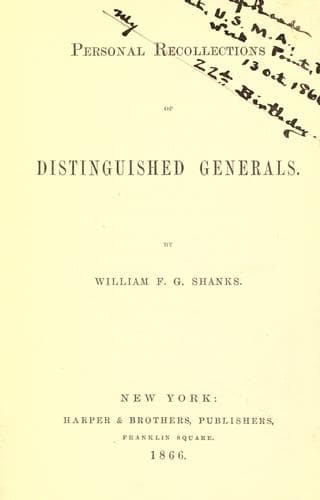
Personal Recollections of Distinguished GeneralsShanks, William Franklin Gore
History
Personal Recollections of Distinguished Generals
Shanks, William Franklin Gore
Generals -- United States; United States -- History -- Civil War, 1861-1865 -- Biography
In manners and habits, as well as in modesty and sternness, General
Buell is not unlike Thomas, possessing the same dignity of deportment,
and reservedness and imperturbability so characteristic of the latter
officer. He possessed, too, the same regular habits of business, and
is a model of reticence and secrecy. He is, if any thing, too cold in
demonstration, and won in consequence, while in the army, a reputation
for gruffness which he did not deserve. He smiled as seldom as Thomas.
One morning, during a recess of the court which was examining into
his conduct at Nashville in December, 1862, he grew unusually lively
in a playful controversy with a young daughter of General Rousseau,
and perpetrated several rather comical jokes. Miss Rousseau, utterly
astonished at this unexpected liveliness on the general's part,
expressed her surprise by exclaiming, "Why, General Buell, I never knew
you to laugh aloud before."
"Ah! my child," replied the general, suddenly growing serious, "you
never knew me when I felt free to laugh as now."
Although very small of stature, General Buell possesses almost
Herculean strength, and frequently has been known to lift his wife, a
lady of at least 140 pounds' weight, at arm's length, and stand her on
a mantle-shelf nearly as high as himself. His frame, compactly built,
is all muscle and sinew.
When Buell was relieved by Rosecrans, the army threw up its hat in
delight, and the country re-echoed their bravos of approval. Never
was joy so inappropriate--never was there a change of commanders so
injudicious, and it required only a year of time, but, alas! many
a human life, to prove how criminal it was. Politics nor war ever
thrust upon the nation a more incompetent leader than William Starke
Rosecrans. He had not one of the attributes of generalship. He was
neither a strategist nor a tactician, and all he knew of the art of
war were its tricks--the tricks that every Indian and all uncivilized
nations most excel in. He inspired dread in his enemies only by his
reputation for trickery, and was known throughout the camps of the foe
as "that wily Dutchman, Rosecrans." He was eminently fitted by nature
and education to be the provost-marshal and chief of spies to a great
army like that which he commanded, but nothing more.
Nature unfitted him for the task of directing a great army by making
him extremely nervous. His nervousness, unlike that of Sherman, was a
weakness. His excitability rendered it not only impossible for him to
execute, but it made him incoherent, and he could not direct others. I
have known him, when merely directing an orderly to carry a dispatch
from one point to another, grow so excited, vehement, and incoherent
as to utterly confound the messenger. In great danger as in small
things, this nervousness incapacitated him from the intelligible
direction of his officers or effective execution of his plans. He
possessed no control over himself, and consequently was not capable of
directing others.
Public-domain text, read in full here on John Shaqi.
Reviews
Reviews
No reviews yet
Be the first to share your thoughts on this work.
Elsewhere in the archive
Join the Discussion
Join the discussion
Sign in to leave a comment or review.
Sign InorCreate an account