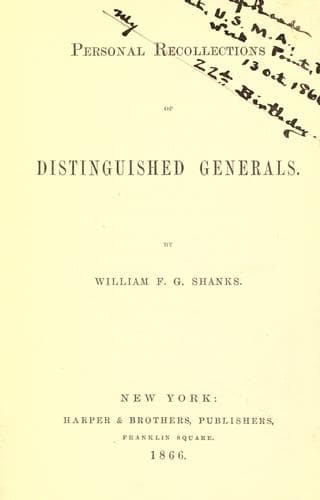
Personal Recollections of Distinguished GeneralsShanks, William Franklin Gore
History
Personal Recollections of Distinguished Generals
Shanks, William Franklin Gore
Generals -- United States; United States -- History -- Civil War, 1861-1865 -- Biography
"The devil!" exclaimed Steedman. "Give 'em thirty, and see whether
they'll work then. I never gave a man less than eighty-seven and a half
cents a day in my life. I think I could get a brigade at that price
here. You try it; and, I say," he added, "if I hear of your offering
less, I'll _try_ you."
The contractor tried the plan, and found he had no use for a military
guard, and no work for half the applicants who swarmed about his office.
Steedman in appearance is like a hale, hearty farmer, with stout, burly
form, largely made, and of great physical power and endurance. He
weighs over two hundred pounds, and is one of the strongest men in the
country. He is as frank as he is bold, and as honest as impudent.
When General Rosecrans retired to Chattanooga during the battle of
Chickamauga, thus abandoning his army, he committed the grand mistake
of his military career. He soon found this to be so, and soon felt and
knew that his unfortunate retreat had left him utterly defenseless.
He feared at first to condemn any one, and endeavored to make friends
with all. He could not condemn McCook and Crittenden, for in running
away from the battle-field they had only followed his example, and to
condemn them for this was to condemn himself. Some victim was necessary
as an explanation of his defeat and retreat, and Generals Thomas J.
Wood and James S. Negley were selected, the latter before and Wood
after the removal of Rosecrans. Negley was a volunteer officer, who
had incurred the enmity of Brannin, Davis, Baldy Smith, and one or two
regular officers of inferior rank, and he was sacrificed by Rosecrans
in order to obtain the support of what was known as the "regular
clique" of the army, and which embraced these and other regular
officers. Wood was not relieved by Rosecrans as Negley was, nor did
Rosecrans venture to publicly censure him until after his own removal,
when, very much to every body's surprise, Rosecrans condemned Wood
in his official report for having caused the disaster to the army.
The fact is that Rosecrans was not entitled to make a report of the
battle of Chickamauga, for he did not see it, was not present, and, as
written, his report, after its description of the general topography of
North Alabama and Georgia, is merely a lame apology for his own strange
conduct.
Public-domain text, read in full here on John Shaqi.
Reviews
Reviews
No reviews yet
Be the first to share your thoughts on this work.
Elsewhere in the archive
Join the Discussion
Join the discussion
Sign in to leave a comment or review.
Sign InorCreate an account